


Is Miles Hacking Only for the Rich? How Singaporeans Can Earn 100,000 KrisFlyer Miles in a Year Without Spending More
September 24, 2026 | by nearme.sg


Many Singaporeans assume business-class travel needs an extra S$5,000 to S$7,000 sitting in your bank account. But what if the better question is not, “Can I afford the ticket?” but “Can I make my usual spending work harder?”
That is the central idea behind miles hacking: earning airline miles from spending you would already do, then redeeming those miles for flights instead of paying the full cash fare.
In a recent discussion about Singapore miles strategies, experienced collectors described accumulating around 800,000 miles in three and a half years and 1.47 million miles over a lifetime. You do not need to copy their nine-card setup. For most beginners, two or three well-chosen cards, careful tracking and a 6- to 12-month plan are enough to make a meaningful difference.
If you are planning a major move, holiday or lifestyle change, you may also find NearMe.SG’s Singapore relocation and budgeting guide useful.
📥 Run the numbers on your own spending first
Before you add another card, know what you actually spend each month. The free Finance Starter Kit helps you map your spending categories, compare rewards against cashback, and set the caps that keep a miles strategy working.
💳 Which card actually earns the miles? Compare Singapore rewards and cashback cards side by side, including Standard Chartered’s Simply Cash card, before you pick your first one.
Disclosure: NearMe.SG may earn a commission from some links on this page. This does not affect our editorial recommendations.
What does miles hacking actually mean?
Miles hacking means matching each spending category to the card that gives you the best reward rate.
Instead of using one general card everywhere, you might use:
-
One card for online shopping and food delivery
-
One card for offline contactless payments
-
One card for Singapore Airlines or Scoot spending
-
A general-spend card when you need to meet a sign-up bonus
The aim is not to spend more. It is to earn more from spending already in your monthly budget.
That distinction matters. Buying things you do not need just to earn miles is not optimisation. It is overspending with extra steps.
The one-card mistake: 48,000 miles a year is not enough
The most common beginner mistake is using only one card for every transaction.
Suppose your card earns 4 miles per dollar and you spend S$1,000 each month:
-
S$1,000 × 4 miles = 4,000 miles monthly
-
4,000 miles × 12 months = 48,000 miles annually
That may sound impressive, but it may not even be enough for a return business-class trip to Japan. It is also much less if your single card earns only 1.2 to 1.4 miles per dollar on general spending.
The practical beginner setup is simple:
-
Start with one card for online spending.
-
Add one card for offline or contactless spending.
-
Consider a third card only when you understand your spending patterns.
-
Stop at three or four cards unless you are comfortable tracking more.
Do not begin with nine cards. More cards do not automatically mean more miles. They create more annual fees, more expiry dates, more minimum-spend requirements and more opportunities to make a costly mistake.

Know where your money goes before choosing a card
Your best card depends on your real spending, not your friend’s recommendation.
For example, if you spend around S$500 a month dining out, a card that rewards dining may be more useful than a card designed mainly for petrol. If you work from home and shop online frequently, an online-spend card may be more valuable than one focused on physical retail.
Review your last three months of spending and divide it into categories:
-
Dining and food delivery
-
Online shopping
-
Groceries
-
Transport and ride-hailing
-
Mobile contactless payments
-
Travel and foreign-currency purchases
-
Insurance, utilities, education and government payments
-
Recurring subscriptions
The last group requires special care. Many rewards cards exclude utilities, insurance premiums, education payments, government transactions, e-wallet top-ups and other specific merchant category codes.
Current Singapore card strategies to understand in 2026
Rates and promotions change, so treat the following as a 2026 snapshot rather than a permanent promise.
KrisFlyer UOB Credit Card
The KrisFlyer UOB Credit Card earns:
-
3 miles per dollar on Singapore Airlines, Scoot, KrisShop, Kris+ and Pelago
-
2.4 miles per dollar on selected dining, online shopping, online travel and transport spending after meeting S$1,000 of Singapore Airlines Group spend during the card membership year
-
1.2 miles per dollar on other eligible spending
-
5,000 welcome miles for eligible first-time applicants, subject to the prevailing offer
Its major advantage is simplicity: miles are credited directly to KrisFlyer, so you generally avoid a separate bank-points conversion fee. Check the official UOB KrisFlyer card page before applying because eligibility, exclusions and promotional terms can change.
DBS Altitude
DBS Altitude is useful as a general travel and sign-up-bonus card:
-
1.3 miles per dollar on local spending
-
2.2 miles per dollar on overseas spending
-
DBS Points convert to KrisFlyer at 2:1
-
A S$27.25 conversion fee generally applies per conversion request
The strategic lesson is important: a general-spend card with a substantial sign-up bonus can be more valuable initially than a specialist card with a higher everyday earn rate but no sign-up bonus. Review the latest DBS Altitude terms and card details.
UOB Preferred Visa
The UOB Preferred Visa, formerly known as UOB Preferred Platinum, offers up to 4 miles per dollar through 10X UNI$ on eligible:
-
Online shopping
-
Entertainment
-
Mobile contactless payments
Other eligible spending earns at the base rate. UNI$ can be transferred to KrisFlyer at 1 UNI$ to 2 miles, with a conversion fee typically around S$27.25.
The bonus rate is capped, and payment method, merchant category and transaction type matter. Do not assume every tap or online transaction qualifies.
Citi Rewards
Citi Rewards is another specialist card commonly used for up to 4 miles per dollar on eligible online shopping, groceries, food delivery and ride-hailing transactions.
The bonus component is capped at 9,000 points per month, so it is not an unlimited 4-miles-per-dollar card. It also has exclusions and a conversion fee when transferring points to KrisFlyer. Check the current Citi Rewards details and terms before relying on a particular merchant category.
AMEX KrisFlyer Ascend
The AMEX KrisFlyer Ascend welcome offer can reach up to 45,000 miles for eligible applicants under the promotion running to 31 January 2027. The offer requires S$8,000 of spending within 180 days and is paid in two tranches.
That can be powerful, but only if the spending is natural and you can repay the balance in full. Annual fees, qualifying transactions and exclusions all matter.
The sign-up bonus sequence that can protect 30,000 miles
The biggest strategic lever is often not the regular earn rate. It is the order in which you apply for cards.
Suppose you are choosing between:
-
A general-spend card with a large sign-up bonus
-
A specialist card earning 4 miles per dollar but offering no sign-up bonus
Take the general-spend card first. Put your normal expenses on it until you meet the minimum-spend requirement and receive the bonus. Then use the specialist card for its bonus categories.
Using the example discussed by the creators, applying for a card such as DBS Altitude before a bonus-category card such as DBS Woman’s World can preserve a sign-up bonus that may be worth roughly 30,000 miles. Taking the specialist card first could mean losing that opportunity.
Once you hit the required spending threshold, set the sign-up-bonus card aside unless its everyday rate or benefits remain attractive.
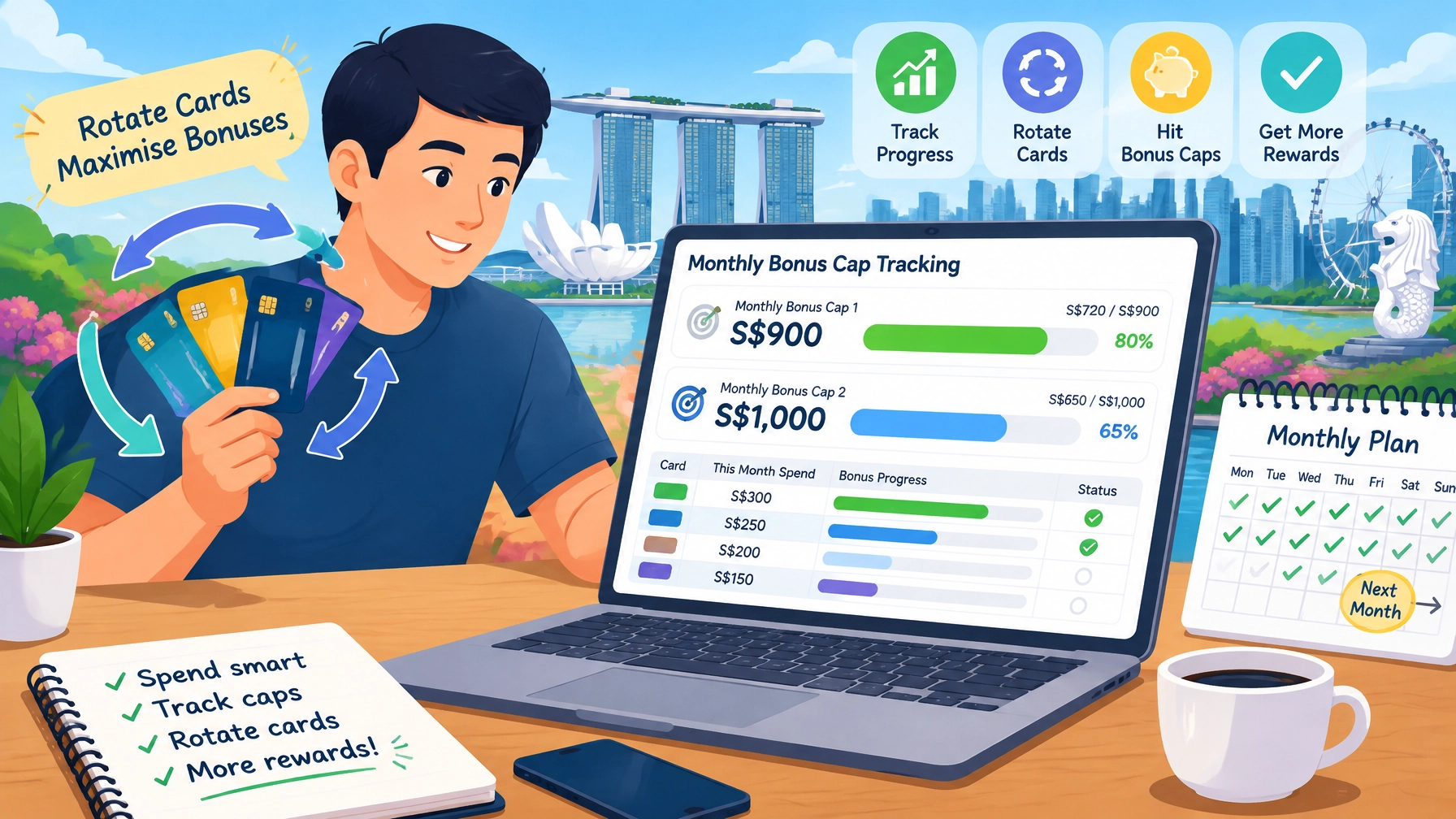
Build a simple tracking system
You do not need a complicated spreadsheet, but you do need a system.
Create a monthly table with:
| Category | Monthly cap | Spend so far | Card to use next |
|---|---|---|---|
| Online spending | S$1,000 | S$900 | Switch after cap |
| Contactless payments | Card-specific | S$500 | Check eligible balance |
| Dining | Card-specific | S$350 | Continue if eligible |
| Sign-up bonus | Minimum spend | 80% complete | Finish naturally |
Many bonus categories have a S$1,000 monthly cap. If you are already near S$900, switch to another eligible card instead of wasting the remaining transactions at a low base rate.
When dining with friends, you can pay the bill on the correct card and ask them to transfer their share to you. Keep records, and do not use this as an excuse to lend money you cannot afford to lose.
Miles versus cashback: which is better?
Here is the simple comparison:
Assume you spend S$1,000 per month for 14 months.
5% cashback card
-
S$50 cashback per month
-
S$50 × 14 months = S$700 cashback
4 miles-per-dollar card
-
4,000 miles per month
-
4,000 × 14 months = 56,000 miles
A Singapore-to-Tokyo Singapore Airlines Saver business-class redemption is approximately 54,500 miles one way, before taxes and fees, subject to availability and award-chart changes.
So the choice becomes:
Would you rather receive S$700 in cash or redeem a one-way business-class flight to Japan?
There is no universally correct answer. If you prefer flexibility, immediate savings or inexpensive economy flights, cashback may be better. If business-class travel is a genuine goal, miles can provide an experience you would probably not buy with cash.

The hidden cost is time
Miles are not free. You pay with planning effort.
Award availability can be limited, especially for Saver business-class seats during school holidays and peak travel periods. You may need to plan close to a year ahead, check availability regularly and remain flexible with dates.
KrisFlyer miles can also expire, and bank points may have their own validity rules. Do not transfer points merely because you have accumulated them. Transfer when you have a realistic redemption plan, because conversion fees are commonly around S$27.25 and transfers may not be reversible.
Before redeeming, compare:
-
Saver versus Advantage pricing
-
Taxes and surcharges
-
Change and cancellation fees
-
Seat availability
-
The cash fare for the same route
-
Whether the miles could deliver better value elsewhere
For current programme information, check Singapore Airlines’ KrisFlyer partner information.
Your practical 100,000-mile starter checklist
Use this as a first-year plan:
-
Review three months of spending.
-
Choose one general-spend or sign-up-bonus card.
-
Meet the minimum spend only through planned expenses.
-
Add one online or contactless bonus card.
-
Track every monthly cap.
-
Check exclusions before making large payments.
-
Keep a backup card when a bonus cap is reached.
-
Check KrisFlyer award availability before transferring points.
-
Redeem before miles or points expire.
-
Pay every card balance in full each month.
Can you earn 100,000 miles in a year? Yes, it is possible for some Singaporeans through a combination of normal spending, welcome bonuses and disciplined card rotation. It is not guaranteed, and it is not a reason to spend beyond your budget.
The best miles strategy is not the one with the most cards. It is the one you can operate accurately without stress, debt or unnecessary purchases.
📥 Build the plan before you build the card stack
Download the free Finance Starter Kit to map your monthly spending, set realistic reward caps and work out whether miles or cashback gives you better value on your own numbers — not someone else’s nine-card setup.
💳 Ready to pick your first card? Compare Singapore credit cards on rewards rate, cashback, caps and annual fees — including Standard Chartered’s Simply Cash card — before you apply.
Disclosure: NearMe.SG may earn a commission from some links on this page. This does not affect our editorial recommendations.
Important: This article is general information, not financial advice. Credit-card rewards, eligibility rules, bonus caps, annual fees, merchant-category exclusions, conversion fees and KrisFlyer redemption rates change. Always read the latest product summary and terms from the bank. Only use credit if you can repay the full balance every month: interest charges can erase the value of your miles completely.
For more practical Singapore guides, explore the NearMe.SG blog hub and compare your broader household planning priorities before adding another card.
Compare on SingSaver →
RELATED POSTS
View all


Carousell Buyer Protection Singapore 2026: How to Avoid Scams & Get Safe Refunds
January 13, 2026 | by nearme.sg

Private Driving Instructor Bukit Batok: Best 2025
November 12, 2024 | by nearme.sg

Canberra Crescent Residences: Expert Guide & Investment Insights
August 2, 2025 | by nearme.sg