


BTO Income Ceiling Raised to S$16,000: What It Means for Property Investors in 2026
August 25, 2026 | by nearme.sg

For Singapore property investors in 2026, few policy changes are as important as the latest adjustment to public housing income ceilings.
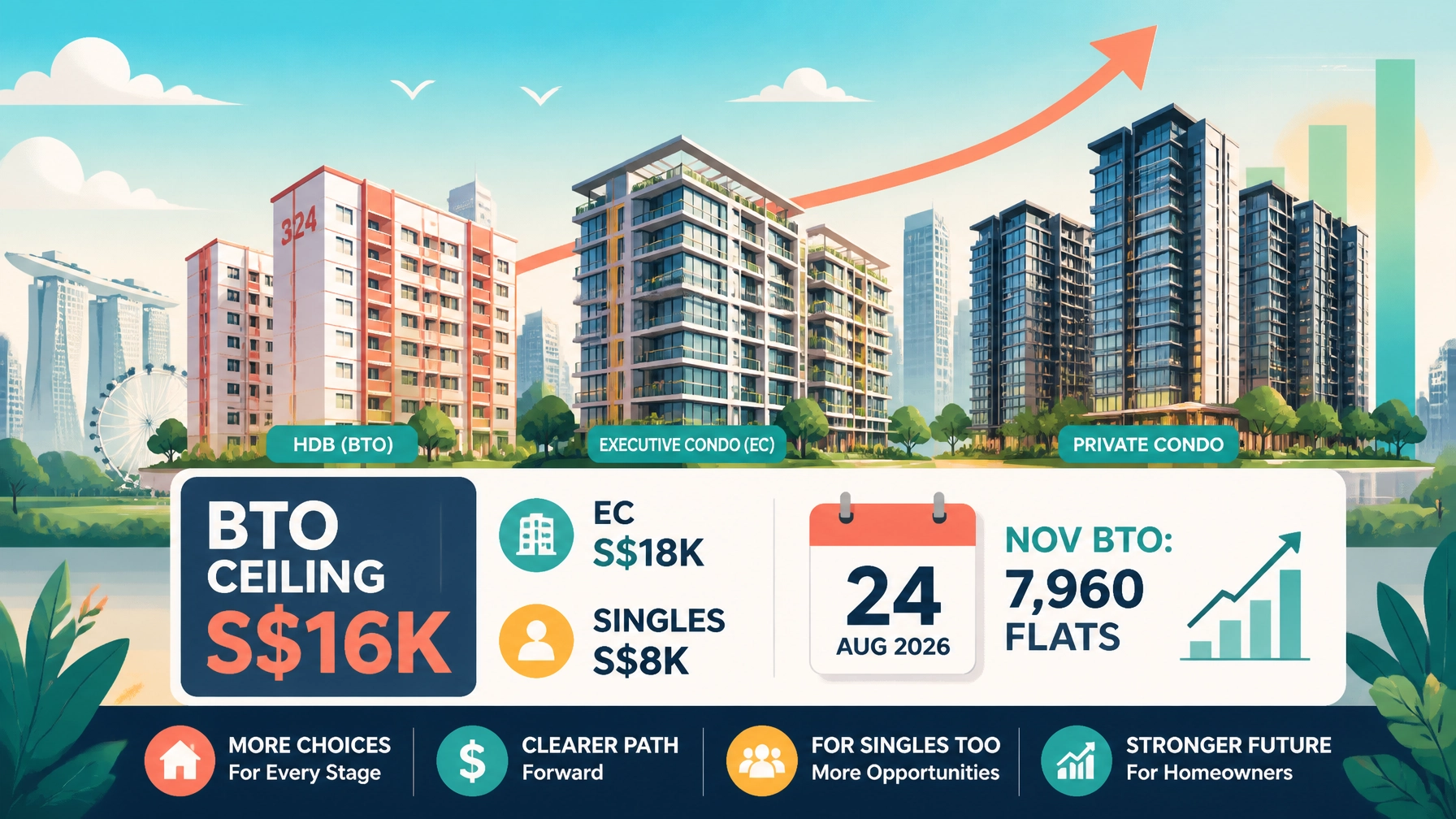
At the National Day Rally on 23 August 2026, Prime Minister Lawrence Wong announced that the monthly household income ceiling for BTO flats will rise from S$14,000 to S$16,000. The Executive Condominium (EC) ceiling will increase from S$16,000 to S$18,000, while the income ceiling for eligible singles rises from S$7,000 to S$8,000.
📥 Free Guide: 2026 BTO Budget Hacks
Get our cheatsheet on navigating the new income ceiling & maximizing grants.
Looking for the best deal on this? You can compare cost per application on SingSaver.
Disclosure: NearMe.SG may earn a commission from some links on this page. This does not affect our editorial recommendations.
The changes apply from 24 August 2026 for new HDB Flat Eligibility (HFE) letters. For ECs, the new S$18,000 ceiling applies only to projects whose land sale tenders close on or after that date.
This is the first income-ceiling adjustment since 2019. For property investors, the announcement is not simply about who can buy a subsidised home. It could reshape demand across the BTO, HDB resale, EC and private condominium markets.
👉 Explore NearMe.SG’s Singapore real estate insights and property guides
What has changed?
| Buyer category | Previous ceiling | New ceiling | Effective date |
|---|---|---|---|
| Families buying BTO or new subsidised HDB flats | S$14,000 | S$16,000 | HFE letters from 24 Aug 2026 |
| New EC projects | S$16,000 | S$18,000 | Land tenders closing from 24 Aug 2026 |
| Eligible singles aged 35 and above | S$7,000 | S$8,000 | From 24 Aug 2026 |
| PPHS applicants | S$7,000 | S$8,000 | From 24 Aug 2026 |
| Seniors’ housing schemes | Existing limits | Up to S$16,000 | Under revised arrangements |
The November 2026 BTO exercise will offer approximately 7,960 flats in Bedok, Geylang, Sembawang, Tengah, Toa Payoh and Yishun.
The timing is significant. Singapore’s median monthly household income reached S$12,446 in 2025, representing 6.8% real growth. More households have therefore moved close to, or beyond, the previous ceiling even though they may still prefer a subsidised flat.
1. HDB resale prices could face more pressure
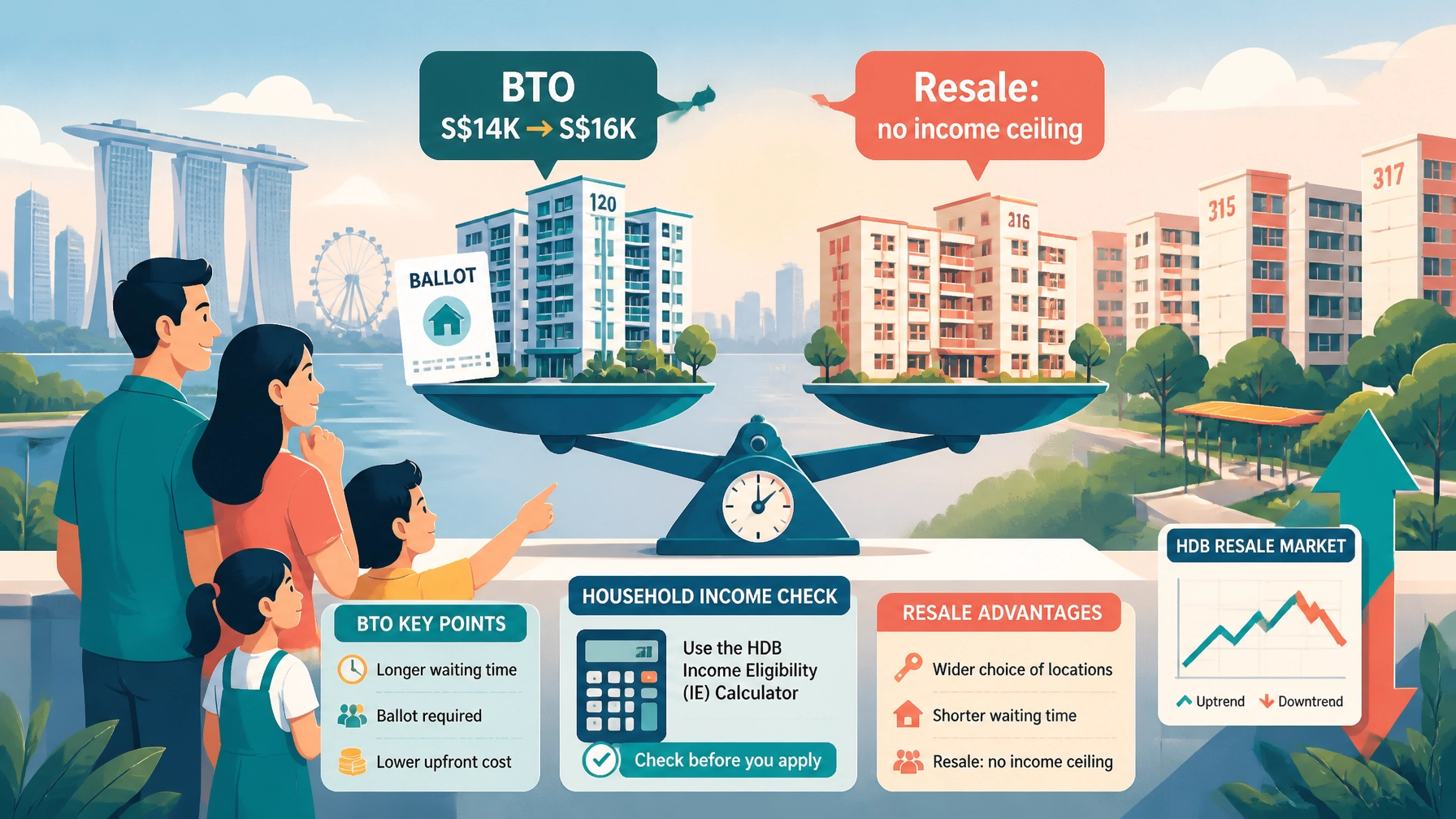
The most immediate property-market impact is likely to be felt in the HDB resale segment.
Families earning between S$14,000 and S$16,000 who were previously excluded from BTO applications can now consider new subsidised flats. Some of these households may have otherwise purchased larger four-room or five-room resale flats in established towns.
That creates a potential demand shift.
In the first quarter of 2026, HDB resale prices fell 0.1% quarter-on-quarter, according to HDB data reported by CNA : the first quarterly decline since the second quarter of 2019. Prices then declined another 0.3% in Q2 2026, marking two consecutive quarterly falls.
At the same time, resale prices remain elevated in popular locations. During Q1 2026:
-
Four-room median prices reached approximately S$1 million in Queenstown and Toa Payoh.
-
Five-room median prices crossed S$1 million in Ang Mo Kio, Bukit Merah and Toa Payoh.
-
The average price of million-dollar flats was about S$1.151 million, down around 1.2% quarter-on-quarter.
The income-ceiling increase will not suddenly cause a crash. Resale HDB flats still serve buyers who need immediate housing, want a specific school location or cannot wait several years for a BTO project.
However, it could reduce the urgency among higher-income households to pay a steep premium for a new resale flat. OrangeTee’s Christine Sun has already pointed to increased BTO supply and shifting buyer preferences as factors weighing on resale demand.
What investors should watch in HDB resale
If you are assessing a resale flat as part of a broader property investment strategy, focus on:
-
Flat age and remaining lease : Older flats may face a narrower buyer pool even when located near transport nodes.
-
Town-level supply : Upcoming BTO launches can affect demand for nearby resale flats.
-
MOP completions : More flats reaching their minimum occupation period may add competing supply.
-
Price gap versus new flats : A large premium for resale may become harder to justify when buyers have more BTO options.
-
Buyer profile : Households above the income ceiling will continue to use the resale market because BTO eligibility remains restricted.
For investors, the key point is simple: HDB resale remains a liquid owner-occupier market, but broad-based price appreciation is no longer a guaranteed outcome.
2. The private condo upgrader pool may become more selective
A common Singapore property investment pathway is:
BTO or resale flat → sell after MOP → upgrade to EC or private condominium.
The new policy changes that pathway in two different ways.
First, some households that would previously have bought resale HDB flats may now enter the BTO market. This could moderate the capital gains available to future upgraders, particularly in large resale flats competing directly with new launches.
Second, higher-income families may have a new subsidised option instead of moving directly into a private condominium. A household earning S$15,000 a month, for example, may now compare a BTO flat with a resale condominium rather than being pushed automatically into the private market.
That could narrow the pool of immediate private-condo upgraders in the short term.
The private market is still resilient, though. Private residential prices rose 0.9% in Q1 2026, while non-landed prices increased 1.3%. The Outside Central Region recorded the strongest non-landed price growth at 2.2%, supported by new-launch benchmarks such as Pinery Residences.
This creates a challenging affordability equation:
-
HDB resale gains are moderating.
-
Private condo prices are still rising.
-
Mortgage affordability remains constrained by borrowing rules such as the Total Debt Servicing Ratio.
-
Construction and land costs continue to support firm new-launch pricing.
For your condo capital appreciation strategy, this means location and entry price matter more than simply buying into the “next hot area”.
A better way to assess condo investment potential
Instead of asking which are the “most profitable condos in Singapore”, assess each project against five practical filters:
-
Transport connectivity: MRT access and future rail infrastructure.
-
Employment nodes: Proximity to business parks, medical hubs and commercial districts.
-
Entry price: Compare the project’s price per square foot with nearby resale condos.
-
Supply pipeline: Several competing launches can restrict rental and resale upside.
-
Exit liquidity: Compact, efficient layouts generally appeal to a broader buyer base.
👉 Read this NearMe.SG property ownership guide before comparing your next investment
3. ECs could attract stronger demand : but pricing will be crucial
The EC income ceiling rising to S$18,000 is arguably the most important change for upgrader demand.
ECs occupy a unique position. They are developed and sold by private developers, but eligible buyers receive housing subsidies and must meet public-housing conditions during the initial period.
The higher ceiling brings more middle-to-upper-middle-income families into the potential EC buyer pool. These households may find ECs more attractive than mass-market private condos because ECs can offer condominium facilities at a lower entry price than comparable private developments.
However, the impact will be gradual.
The revised S$18,000 limit applies to new EC projects whose land tenders close from 24 August 2026. It does not apply to balance units in existing EC projects or projects based on land awarded before the effective date.
Recent policy changes : including the removal of the Deferred Payment Scheme and a longer minimum occupation period : also limit the extent to which the higher income ceiling can inflate demand overnight.
For investors, the real question is whether developers will price new EC land and launches aggressively in anticipation of stronger demand. If land bids rise, the benefit of wider eligibility could be partly absorbed by higher launch prices.
That makes the launch-to-resale spread essential in any Singapore condo resale profit analysis.
👉 Track NearMe.SG’s real estate investment category for practical market updates
4. November’s BTO exercise will be the first major test
The November 2026 BTO launch will provide the clearest early signal of how buyers respond to the new ceiling.
Huttons’ Lee Sze Teck expects the overall application rate to rise to around 3.5 to 4.0 applications per flat, compared with approximately 3.4 in June. PropNex CEO Kelvin Fong also expects stronger demand for well-located BTO projects.
But the headline application rate will not tell the whole story. Investors should break the data down by:
-
Flat type.
-
Town.
-
Standard, Plus or Prime classification.
-
First-timer versus second-timer demand.
-
Application rates among higher-income newly eligible households.
A well-located BTO in Bedok or Toa Payoh may attract substantially stronger demand than a project in a less mature estate, even if both are available under the revised ceiling.
The additional ballot chance per Singaporean child, scheduled from February 2027, could also influence family demand and improve the odds for eligible applicants over time.
5. A larger HDB loan does not mean unlimited purchasing power
ERA’s Marcus Chu highlighted another practical effect: some newly eligible households may qualify for larger HDB loans and require less cash upfront.
That could strengthen BTO purchasing power. But investors should avoid treating income-ceiling eligibility as proof of affordability.
A household’s actual budget depends on:
-
CPF balances.
-
Existing car, education or renovation loans.
-
Interest-rate assumptions.
-
Loan tenure.
-
Downpayment requirements.
-
Household stability and employment outlook.
-
Future childcare and education costs.
In other words, a buyer may qualify for a flat but still be financially stretched. That distinction matters because affordability ultimately determines transaction volume, not policy eligibility alone.
2026 property investor watchlist
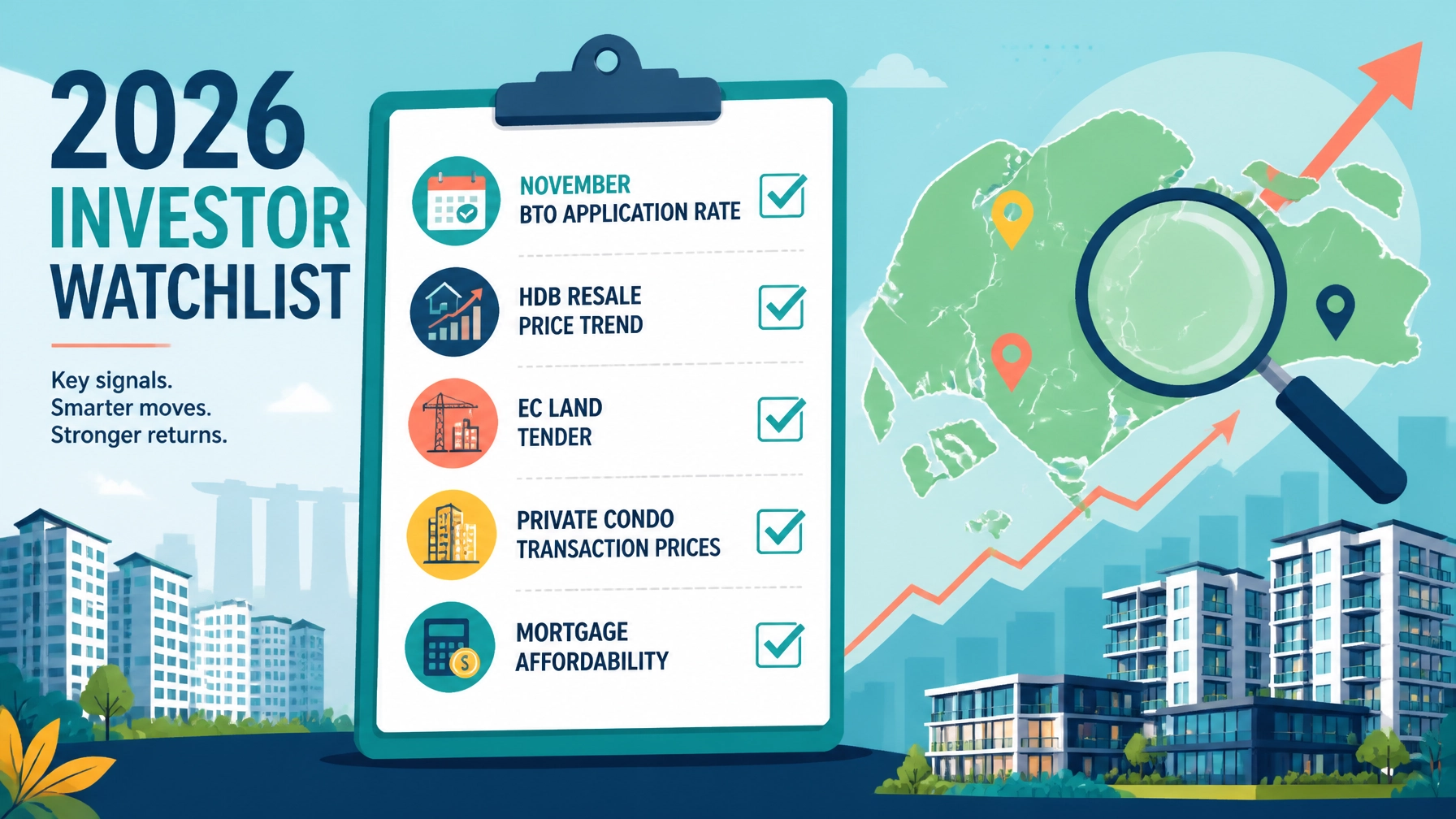
Over the next 12 to 18 months, monitor these indicators:
-
November BTO application rates : especially in Bedok, Geylang and Toa Payoh.
-
HDB resale transaction prices : not just headline million-dollar deals.
-
MOP supply : a rise in listings could cap resale price growth.
-
EC land-tender results : higher bids may signal developer confidence but also future pricing pressure.
-
Private condo resale volumes : liquidity is essential when planning your exit.
-
Price gaps between ECs, resale condos and new launches : this is where value can appear or disappear quickly.
-
Mortgage affordability : income growth does not eliminate interest-rate risk.
Bottom line for Singapore property investment in 2026
The higher BTO income ceiling is a meaningful housing-policy reset, but it is not an automatic bullish signal for every property segment.
For HDB resale investors, the new ceiling could divert some demand toward BTO flats and place additional pressure on expensive larger flats. For private condos, the upgrader pool may become more selective as households gain another subsidised option. For ECs, demand should broaden, but developers may respond with higher land bids and launch prices.
The strongest opportunities will likely be found through disciplined comparison : location, lease, supply, financing and exit demand : rather than by chasing the latest policy headline.
Singapore’s property market is entering a more measured phase. That is not bad news. It rewards investors who do the numbers early, identify genuine scarcity and avoid paying tomorrow’s premium today.
This article is for general information only and does not constitute financial, tax or property-investment advice. Always verify eligibility and financing details with HDB, your lender and qualified professionals before making a purchase.
Sources
Compare on SingSaver →
📥 Free Guide: 2026 BTO Budget Hacks
Get our cheatsheet on navigating the new income ceiling & maximizing grants.
Looking for the best deal on this? You can compare cost per application on SingSaver.
Disclosure: NearMe.SG may earn a commission from some links on this page. This does not affect our editorial recommendations.
RELATED POSTS
View all


5 Secret Budget Date Spots in Singapore: Easy For Wallet 2026
January 27, 2026 | by nearme.sg
Canberra Crescent Residences: Expert Guide & Investment Insights
August 2, 2025 | by nearme.sg

Is Miles Hacking Only for the Rich? How Singaporeans Can Earn 100,000 KrisFlyer Miles in a Year Without Spending More
September 24, 2026 | by nearme.sg