


P1 Registration Shake-Up 2026: What the New Phase 2C Rules Mean for Singapore Property Prices
September 22, 2026 | by nearme.sg
Few policy changes matter more to family-home demand in Singapore right now than the latest Primary 1 registration shake-up.
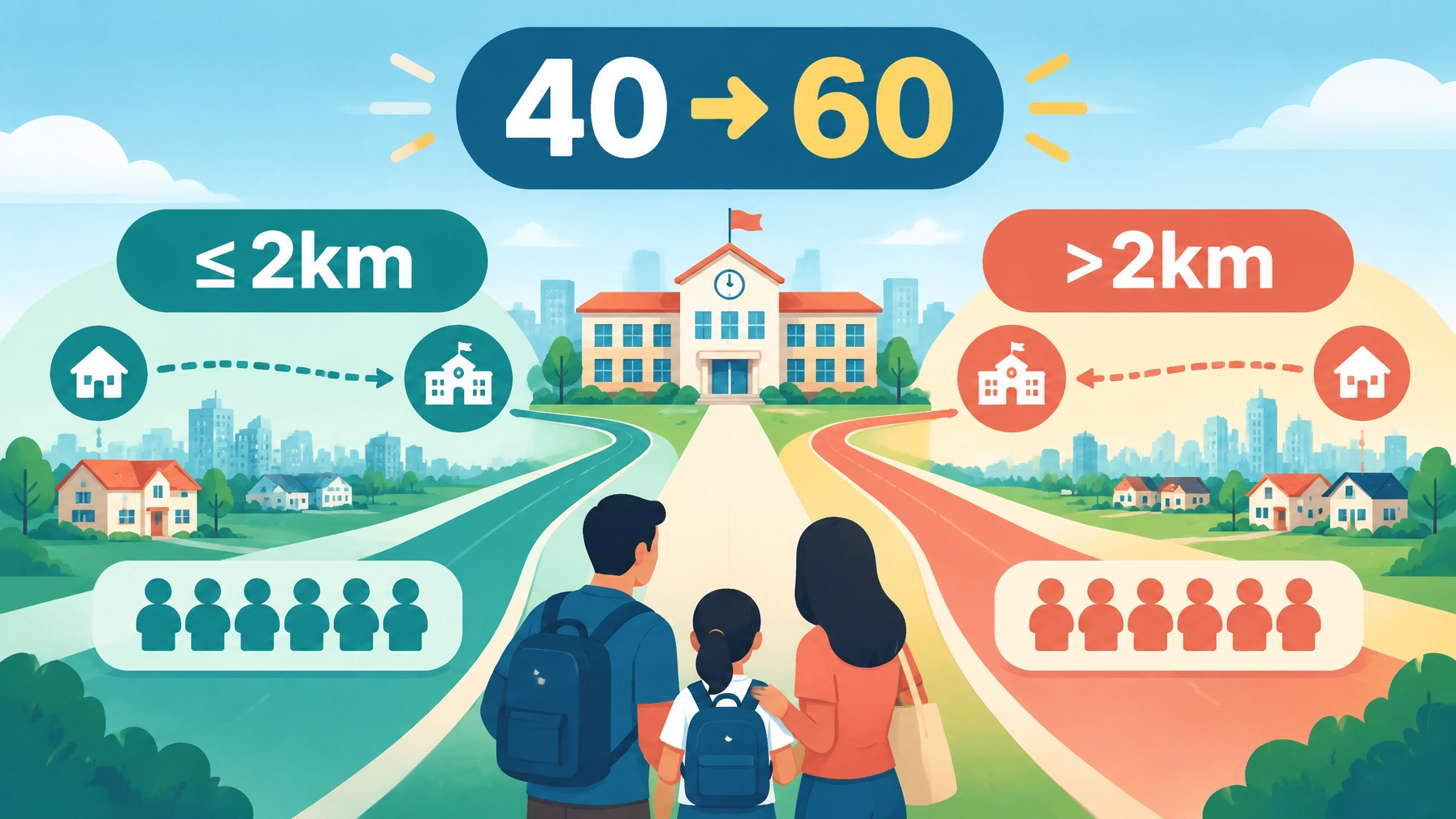
The Ministry of Education (MOE) announced on 10 September 2026 that the revised framework will take effect from the 2027 P1 Registration Exercise, for children starting Primary 1 in 2028. The headline changes are clear: most schools will reserve 60 Phase 2C places instead of 40, while 12 popular schools will introduce a new two-track system.
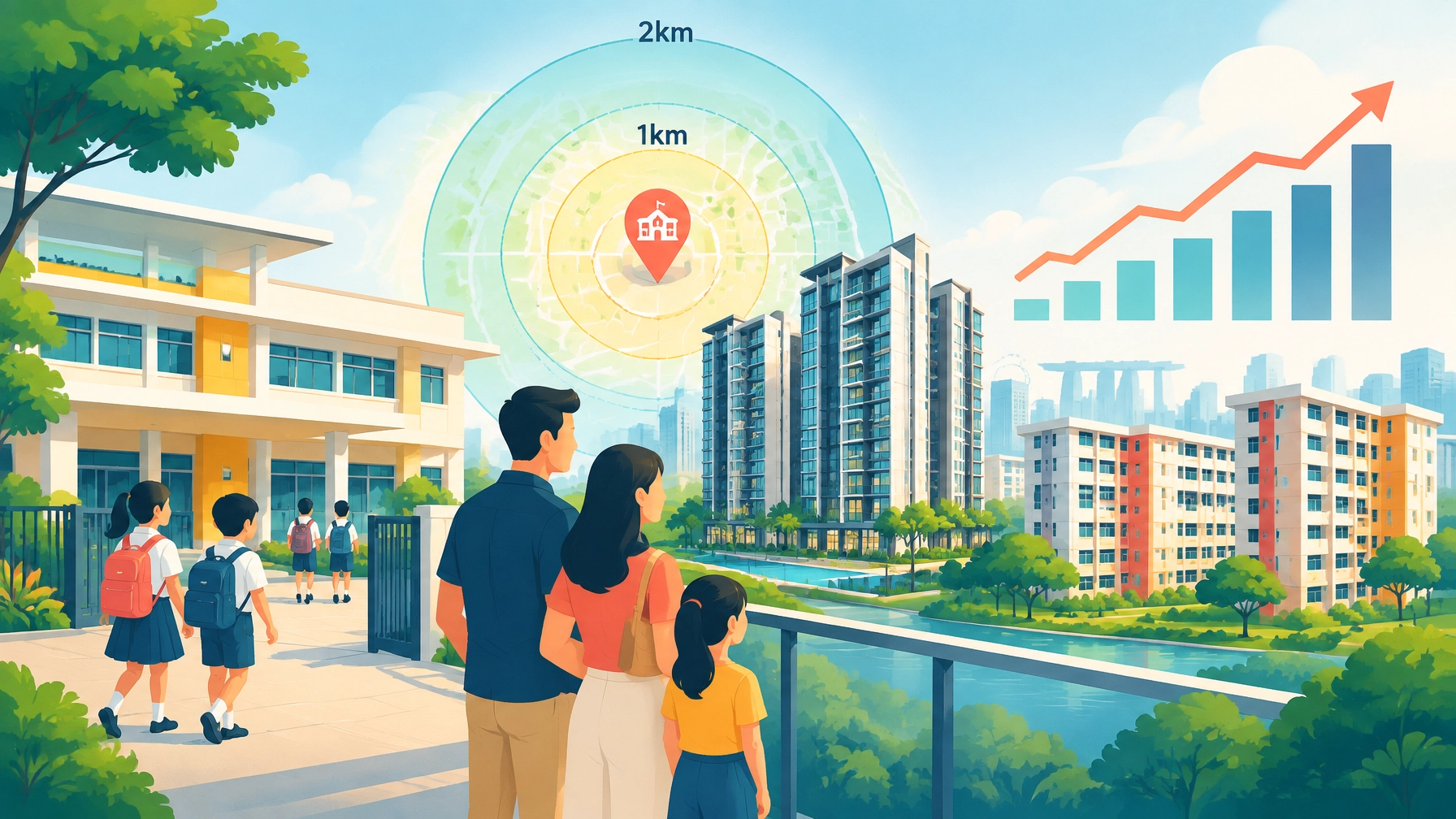
So, does living within 1km of a sought-after primary school still justify paying a premium?
The short answer: the premium has not disappeared, but the case for paying an extreme price purely for school proximity has weakened. Demand may spread across a wider area, particularly around the 12 affected schools.
Before comparing neighbourhoods, use the 🚨 FREE SINGAPORE PROPERTY BUYER CHECKLIST to review financing, valuation, lease, location and resale risks.
📥 Buying near a school zone? Run the numbers first
School proximity is one line in a long list: financing, valuation, lease decay, location and resale risk all decide whether the premium actually pays. The free Singapore Property Buyer’s Checklist walks you through all of them before you commit.
💰 Funding a school-zone upgrade, renovation or bridging loan? Compare a S$120 cash payout personal loan option — free to check, no obligation.
Disclosure: NearMe.SG may earn a commission from some links on this page. This does not affect our editorial recommendations.
What is changing in Primary 1 registration?
The first change applies nationwide, except to smaller-intake schools.
From the 2027 exercise:
-
Phase 2C reserved places increase from 40 to 60 in most schools.
-
Schools with fewer than 180 Primary 1 places retain 40 reserved places.
-
In 2026, 27 of Singapore’s 179 primary schools had intakes below 180 places.
-
Phase 2B remains at 20 reserved places.
-
Phase 2C remains open to children without alumni, sibling or other prior connections.
The additional 20 Phase 2C places will come from earlier registration phases, particularly Phase 2A. Families with alumni or other qualifying ties still receive priority over Phase 2C applicants, but fewer places will remain for those earlier phases.
For example, in a school with 240 places:
| Allocation | Previous framework | From 2027 |
|---|---|---|
| Phase 1 | 90 places | 90 places |
| Phase 2B | 20 places | 20 places |
| Phase 2C reserved places | 40 places | 60 places |
| Remaining places for Phase 2A | 90 places | 70 places |
The policy is designed to widen access for children without prior school connections while continuing to recognise alumni and community contributions.
The new two-track scheme for 12 popular schools
The more significant property-related change affects 12 schools located in neighbourhoods where public housing accounts for less than 40% of dwelling units within 2km.
The schools are:
-
Anglo-Chinese School (Junior)
-
Anglo-Chinese School (Primary)
-
CHIJ (Katong) Primary
-
Methodist Girls’ School (Primary)
-
Nanyang Primary School
-
Ngee Ann Primary School
-
Pei Hwa Presbyterian Primary School
-
Raffles Girls’ Primary School
-
Singapore Chinese Girls’ Primary School
-
St Margaret’s School (Primary)
-
Tanjong Katong Primary School
-
Tao Nan School
Their 60 Phase 2C places will be divided equally:
-
Phase 2C (≤2km): 30 places for families living within 2km.
-
Phase 2C (>2km): 30 places for families living beyond 2km.
There is no additional distance priority within either track. A family living 300 metres from the school has no Phase 2C distance advantage over one living 1.8km away. Both enter the same ≤2km track.
Singapore Citizens continue to receive priority over Permanent Residents. If one track is undersubscribed, remaining places flow to Singapore Citizen applicants in the other track. If the number of places is odd, the extra place goes to the ≤2km track.
MOE will periodically review the list, although it does not expect frequent changes. ACS (Primary) will move to Tengah in 2030 and will no longer be included once its surrounding housing profile changes.
Read the official MOE explanation of the revised P1 registration framework before making any property decision based on school access.
Why did MOE make these changes?
MOE’s stated objectives are to:
-
Improve access for children without prior connections to a school.
-
Encourage greater socio-economic mixing.
-
Keep primary schools open and inclusive.
-
Reduce the extent to which a school’s immediate neighbourhood determines its student profile.
This matters because the existing system gives priority according to citizenship and home-school distance when balloting is required. In areas dominated by private housing, the current framework may not significantly broaden access to families from different housing backgrounds.
The two-track model preserves access for nearby families while creating a separate route for applicants living further away. It is not a guaranteed admission route. Oversubscribed tracks will still require balloting.
Does the 1km property premium still pay?
The traditional “1km premium” is built on a simple assumption: the closer your home is to a popular primary school, the stronger your child’s Phase 2C odds.
That logic remains relevant for many schools. However, at the 12 two-track schools, the difference between 300 metres and 1.8km becomes less meaningful under Phase 2C.
This could moderate the premium for homes that command a substantial markup purely because they sit inside the 1km boundary. Parents may now consider properties further away while retaining access to the ≤2km track.
The data shows why this matters. A Realion Research study found that resale condominiums within 1km of Nanyang Primary School rose 18.2% between H1 2022 and H1 2026, compared with 12.4% for the wider District 10 market. That is an outperformance of 5.8 percentage points.
Other school zones also recorded strong growth:
| School zone | Resale condominium price growth |
|---|---|
| Nanyang Primary School | +18.2% |
| Wider District 10 | +12.4% |
| Rosyth School | +46.8% |
| Nan Chiau Primary School | More than +30% |
| Maris Stella High School | More than +30% |
| Pei Hwa Presbyterian Primary School | More than +30% |
Only Pei Hwa Presbyterian Primary School appears on the new 12-school list.
These figures demonstrate that school proximity can support capital appreciation, but they do not prove that the school alone caused the increase. MRT access, limited land supply, project quality, district status and broader market conditions also matter.
That is the key lesson for anyone researching a condo capital appreciation strategy or conducting a Singapore condo resale profit analysis: school proximity is valuable, but it is not a complete investment thesis.
Which areas could benefit from wider demand?
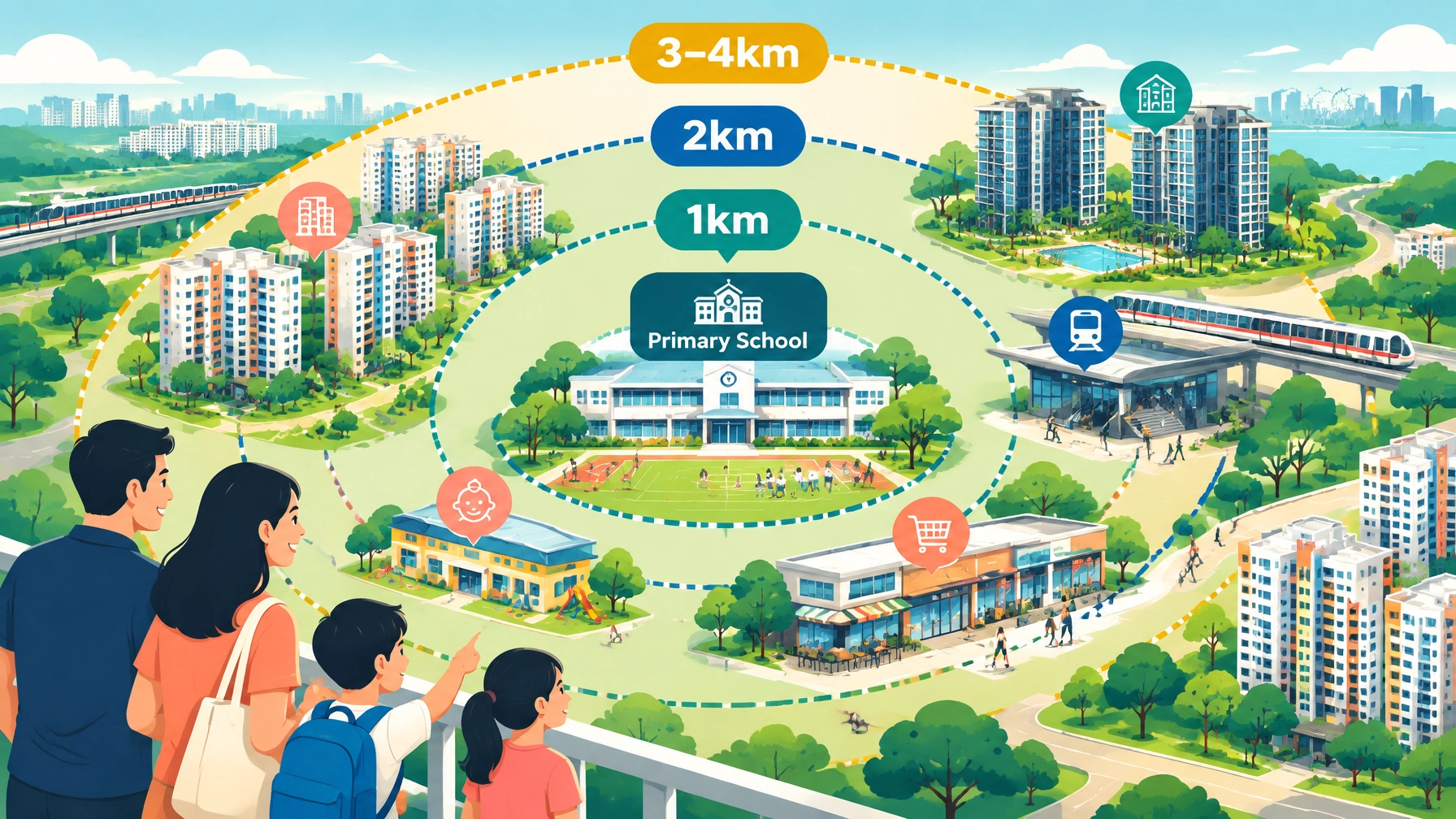
The new rules may widen the geographical area parents consider. Huttons senior director of data analytics Lee Sze Teck suggested that an ideal distance could become approximately 3–4km, or a 10–15 minute journey, rather than a strict focus on the nearest possible address.
Potential areas include:
| Target school area | Possible wider search areas |
|---|---|
| ACS (Junior) | Toa Payoh, Kallang/Whampoa and Bukit Merah |
| Nanyang Primary | Queenstown and nearby city-fringe areas |
| Eastern schools, including Tao Nan and Tanjong Katong Primary | Bedok and Marine Parade |
| Raffles Girls’ Primary and SCGS | Mount Pleasant and nearby new housing areas |
| Tao Nan School | Bayshore and surrounding East Coast locations |
Christine Sun of Realion Research noted that families in new growth areas could increasingly consider nearby popular schools. For example, households in Mount Pleasant may look at Raffles Girls’ Primary and SCGS, while families in Bayshore may consider Tao Nan School.
The price gap between private and public housing also makes these wider-radius locations important. Based on 2026 townwide medians:
-
Marine Parade: resale condominium of approximately 900–1,000 sq ft at S$2.13 million versus a 4-room HDB flat at S$632,500.
-
Bedok: comparable resale condominium at approximately S$1.43 million versus a 4-room HDB median of S$600,000.
-
Toa Payoh: the 4-room HDB median is roughly half the price of a comparable resale condominium.
That price difference gives HDB upgraders and parents more room to balance school access against affordability.
What analysts expect for property prices
The analyst views are broadly consistent, although they differ on the scale of the impact.
-
ERA key executive officer Eugene Lim expects demand near the 12 schools to remain resilient. Many are in prime districts such as Bukit Timah and Marine Parade, where buyers value location, amenities and prestige beyond school access.
-
Christine Sun of Realion expects demand within 2km to remain firm because parents may perceive less competition within that pool. However, she does not expect robust demand alone to cause prices to escalate, since families no longer need to live as close as possible.
-
PropNex head of research and content Wong Siew Ying expects a slight moderation or redistribution of school-driven demand. The incentive to pay a premium for a home within 1km may weaken, but no particular HDB town is a guaranteed beneficiary because homes beyond 2km receive no direct distance advantage.
-
Huttons senior director of data analytics Lee Sze Teck expects the home-search radius to widen towards 3–4km.
The likely outcome is not a sudden property price crash near the 12 schools. Instead, expect a gradual adjustment: less concentration of demand at the school gate, stronger comparison-shopping across nearby neighbourhoods and more attention to transport and amenities.
Buyer decision checklist: should you pay for proximity?
| Question | What to check |
|---|---|
| Is the school one of the 12? | If yes, the 1km-versus-1.8km difference is less decisive in Phase 2C. |
| Is the property within 2km? | This still determines which two-track pool you enter. |
| Are you buying purely for school access? | Recalculate the premium because future rules may change. |
| Does the home have MRT access? | Strong connectivity supports resale and rental demand beyond the school cycle. |
| Is the price gap justified? | Compare against similar homes 2–4km away. |
| Can you afford an HDB alternative? | HDB may offer a much lower entry price while preserving neighbourhood access. |
| What happens if admission is unsuccessful? | The property must still work for your finances, commute and lifestyle. |
| Are there future supply risks? | Check nearby GLS sites, BTO projects and upcoming developments. |
For sellers already within 1km, there is no need to panic. ERA’s view is important: these neighbourhoods remain desirable for multiple reasons. A well-connected condominium near shops, parks, reputable schools and public transport still has a broad resale audience.
For buyers, however, the calculation has changed. You should no longer assume that paying the highest possible price for the smallest distance automatically delivers the best outcome.
For a deeper review of affordability, loan limits, stamp duties and resale risks, use the ✅ NEARME.SG PROPERTY GUIDE FOR SINGAPORE BUYERS.
📥 Don’t pay tomorrow’s premium today
Download the free Singapore Property Buyer’s Checklist and pressure-test your next purchase: financing headroom, valuation gaps, remaining lease, location fundamentals and resale exit risk — the five filters that matter far more than a single registration boundary.
💰 Financing your next move? Compare personal loan options across Singapore lenders with a potential S$120 cash payout — free to check, no commitment.
Disclosure: NearMe.SG may earn a commission from some links on this page. This does not affect our editorial recommendations.
The bottom line for Singapore property investment in 2026
The 2027 P1 registration changes weaken the old “doorstep school or nothing” strategy, particularly around the 12 schools adopting the two-track Phase 2C scheme.
The ≤2km radius still matters, but the premium for being within 1km may moderate because families within that track no longer receive finer distance priority. At the same time, homes 3–4km away could attract more interest if they offer better value, MRT connectivity and comparable family amenities.
If you are buying for your own family, prioritise a home that remains comfortable and financially sustainable even if school admission does not go as planned.
If you are investing, focus on the complete location package: transport, amenities, land scarcity, rental demand, project quality and future supply. That is the more durable Singapore property investment 2026 strategy, and a safer route than betting everything on a single registration boundary.
MOE’s official press release and framework details are available here.
Frequently asked questions
Will homes within 1km of the 12 schools lose value?
Not necessarily. Analysts expect demand to remain firm because these neighbourhoods offer strong amenities, connectivity and prestige. However, the extra premium for being within 1km may moderate.
Does living within 2km still matter?
Yes. Families living within 2km enter the Phase 2C ≤2km track. However, there is no distance priority within that track.
Will homes beyond 2km benefit?
Potentially. The new >2km track gives families living further away a defined pool of Phase 2C places at the 12 affected schools. Demand may also widen towards nearby HDB towns and new growth areas.
Are all primary schools moving to the two-track system?
No. The two-track system initially applies to 12 schools. Other schools will generally retain distance-based Phase 2C priority, while most will increase reserved places from 40 to 60.
Should parents buy a condominium near a popular primary school?
Only if the purchase works beyond school admission. Compare the price premium against HDB alternatives, nearby homes 2–4km away, transport access, rental demand and your expected holding period.
This article is for general information only and does not constitute financial, tax or property-investment advice. Always verify school registration rules, eligibility and financing details with MOE, your lender and qualified professionals before making a purchase.
RELATED POSTS
View all

The Ultimate New Homeowner Checklist: Moving In & Getting Settled (Singapore 2026)
August 10, 2026 | by nearme.sg
Promenade Peak Condo D9 Prestige CCR Living: Free Guide
June 26, 2025 | by nearme.sg