

Last updated
A personal loan in Singapore is an unsecured loan that you repay in fixed monthly instalments. As checked on 25 October 2026, the lowest EIRs the banks in the table below publish range from 1.75% a year (Standard Chartered CashOne, advertised rate from 0.90%) to 10.96% a year (OCBC ExtraCash, on a 60-month loan), and the rate you’re offered depends on your credit and income profile. Banks quote headline rates on different bases: most quote a flat or “applied” rate, while OCBC quotes 10.08% a year on a monthly-rest basis, which it says is equivalent to a flat rate of about 5.4% to 5.5% depending on tenure. The figure to compare is the effective interest rate (EIR), which includes fees and the reducing balance. This guide sets out what banks publish, the rules MAS and the Ministry of Law set, and what to check before you borrow.
This article is general information, not financial advice. It doesn’t take your personal circumstances into account, and we aren’t a licensed financial adviser. Rates and fees change often, so check the lender’s own page and loan agreement before you apply.
What is a personal loan?
A personal loan is a lump sum from a bank or licensed lender that you repay in fixed monthly instalments over a set tenure. Most bank personal loans are unsecured, so there’s no collateral. People use them for things like renovation, weddings, travel, medical bills or consolidating other debts. UOB, for example, lists these among the possible uses on its personal loan page.
Credit card balances that aren’t paid in full cost much more. As checked on 25 October 2026, HSBC lists an effective rate of 27.8% a year (minimum) on its Revolution card, and Citi’s Cash Back+ information sheet lists a prevailing retail interest rate of 27.9% a year.
Flat rate vs EIR: how personal loan interest works
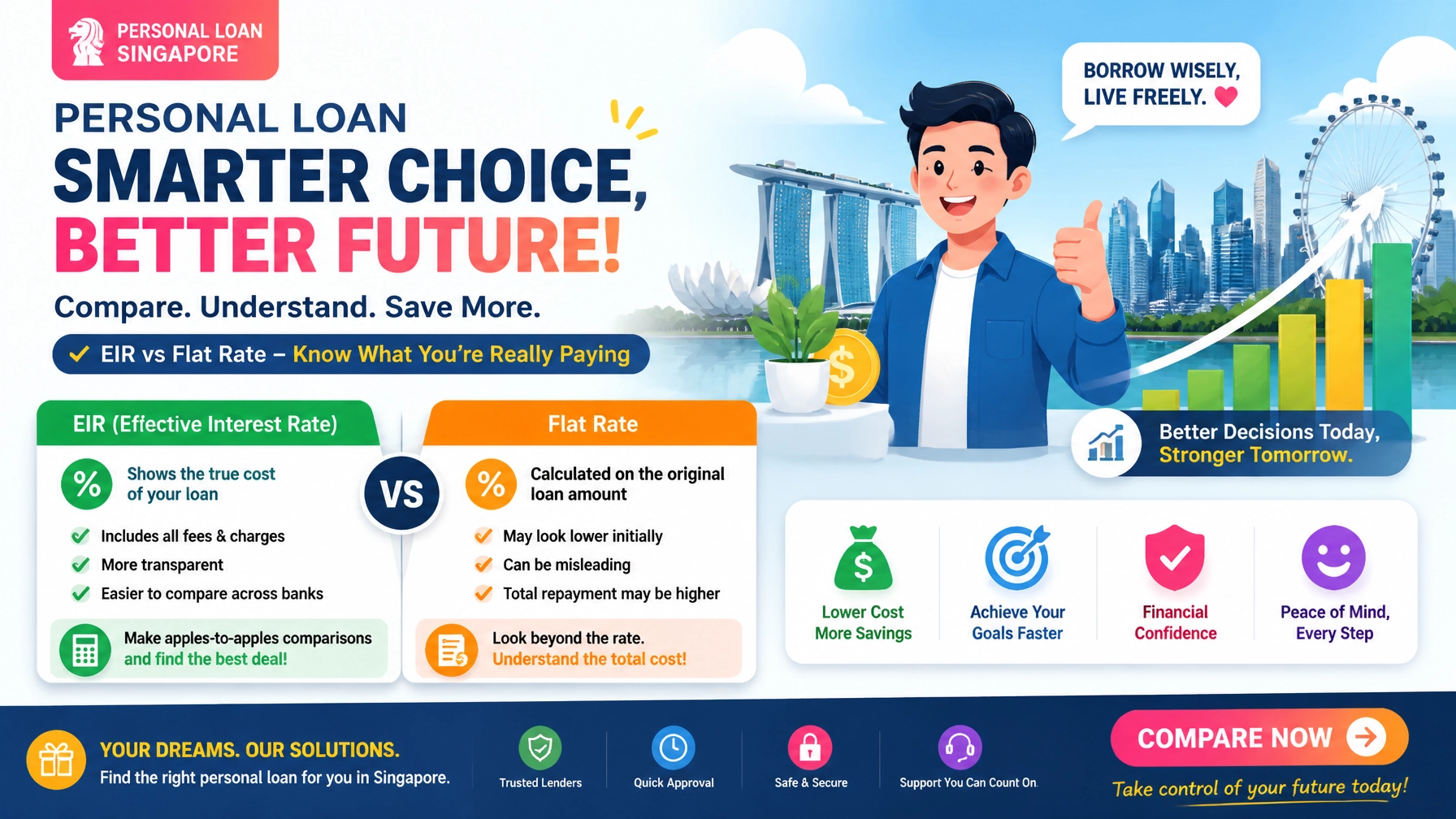
Banks often advertise an “applied” or flat rate. It’s charged on the original loan amount for the whole tenure, even as you repay. For example, a 2% flat rate on S$10,000 over 5 years is S$200 of interest a year, or S$1,000 in total.
The effective interest rate (EIR) reflects the cost on a reducing-balance basis and usually includes fees. DBS describes it as “the rate that reflects the true cost of borrowing… useful in comparing different loans”. That’s why the EIR is higher than the advertised rate. DBS’s own example: S$3,000 at 1.99% a year plus a 1% processing fee over 12 months has an EIR of 5.47% a year.
Some banks also say how interest is allocated across instalments. DBS uses the Rule of 78, so a larger share of each early instalment goes to interest. This matters if you repay early.
Personal loan rates and fees in Singapore compared
| Lender and loan | Lowest advertised rate (EIR) | Fees | Tenure | Minimum income (SC/PR; foreigners) | Early repayment |
|---|---|---|---|---|---|
| Standard Chartered CashOne | From 0.90% a year (EIR from 1.75%; 2.15% including the first-year fee, on S$20,000 over 5 years) | First-year annual fee of S$199 | 1 to 5 years | S$30,000; S$90,000 (Employment Pass holders) | See bank terms |
| UOB Personal Loan | From 1.00% a year (EIR from 1.93%); highest 8% a year (EIR 17.62%) | UOB states processing fees are waived for all tenors | 1 to 5 years | S$30,000 (SC/PR only, age 21 to 65) | S$150 or 3% of the outstanding balance, whichever is higher |
| DBS Personal Loan | From 1.48% a year (EIR 3.22%) | 1% processing fee | 6 to 60 months | S$20,000; S$60,000 | S$250 per loan |
| OCBC ExtraCash Loan | 10.08% a year on a monthly-rest basis (OCBC’s flat-rate equivalent 5.42% to 5.54%); EIR from 10.96% (60 months) to 13.92% (12 months), for income of S$30,000 and above | S$200 or 2% of the approved amount, whichever is higher | 12 to 60 months | S$20,000 (SC/PR) | See bank terms |
| Trust Bank Instant Loan | See Trust’s page (rate depends on amount, tenure and credit profile) | 0.88% first-year annual fee on loans from 25 Feb 2026 | 3 to 60 months | S$30,000; S$60,000 (age 21 to 65) | 3% of the outstanding principal |
What to compare before you apply
- EIR, not the headline rate. Compare loans on EIR for the same amount and tenure.
- Fees. Processing fees and annual fees differ by bank and raise the EIR, especially on short tenures.
- Early repayment or cancellation fees. These range from a flat fee (S$250 at DBS) to a percentage of the outstanding amount (3% at Trust; S$150 or 3%, whichever is higher, at UOB).
- Late payment. At UOB, for example, the late charge and finance charges of the linked credit card or CashPlus account apply if an instalment isn’t paid in full by the due date.
- Total cost. Ask for the total interest and fees payable over the full tenure, and the monthly instalment, in writing before you accept.
Types of personal loans and debt products
- Term personal loan. A fixed amount repaid in fixed instalments, such as the loans in the table above.
- Balance or funds transfer. Moves money from your credit limit at a low or 0% interest rate for a short period, usually with a processing fee. Standard Chartered, for example, lists 0% interest with processing fees from 0.90% (EIR from 2.06%) over 3, 6, 9 or 12 months.
- Debt Consolidation Plan (DCP). An industry scheme that combines your unsecured debts across financial institutions into one loan with one participating bank. According to the Association of Banks in Singapore, you must be a Singapore Citizen or PR, earn at least S$20,000 and below S$120,000 a year with net personal assets under S$2 million, and have interest-bearing unsecured debt of more than 12 times your monthly income. Renovation, education and medical loans, business credit and joint accounts are excluded. Banks may apply their own criteria.
- Renovation loan. A separate product for renovation works, often with its own limits. See our guide to renovation and bridging loans in Singapore.
MAS borrowing limits and how loans affect your TDSR
Under MAS rules, if your interest-bearing unsecured debt across all financial institutions exceeds 12 times your monthly income for three consecutive months, you can’t get more credit and your existing facilities are suspended. The limit was phased in from 24 times (June 2015) to 18 times (June 2017) to 12 times (June 2019). It counts card balances that are rolled over, unsecured loans that accrue interest, and interest charged on other debt. Banks may lift the suspension to consolidate and refinance your debts with one institution.
If you plan to buy property, personal loans also count as monthly debt in your Total Debt Servicing Ratio (TDSR), which MAS caps at 55% of gross monthly income for property loans (MAS TDSR rules).
Eligibility and documents
Each bank sets its own age and income criteria (see the table). Applying through Myinfo (Singpass) usually means you don’t have to upload income documents, and existing cardholders at DBS, UOB and Standard Chartered may not need to provide documents. Otherwise, DBS lists these for new customers:
- Salaried Singaporeans and PRs: NRIC (front and back) and the latest 3 months’ computerised payslips. The latest Income Tax Notice of Assessment is optional.
- Commission-based or self-employed: NRIC and the latest 2 years’ Notices of Assessment (or at least 1 year).
- Foreigners: passport and work pass (each valid for at least 6 months), payslips and, for new DBS customers, proof of residential address.
Lenders check your credit report with Credit Bureau Singapore (CBS). You can buy your own CBS report to check it for errors before applying.
Licensed moneylenders: the legal caps
Some borrowers turn to licensed moneylenders when they can’t get bank credit. According to the Ministry of Law’s Registry of Moneylenders, as checked on 25 October 2026:
- Interest is capped at 4% a month, and late interest at 4% a month on the amount repaid late.
- Fees are limited to an upfront fee of up to 10% of the principal, a late fee of up to S$60 a month, and court-ordered legal costs.
- Total interest, late interest and fees can’t exceed the amount of the original principal.
- For unsecured loans, total borrowing across all moneylenders is capped: S$3,000 for Singaporeans and PRs earning under S$20,000 a year (S$500 for foreigners earning under S$10,000), and 6 times monthly income for anyone earning S$20,000 or more.
- You can cancel an unsecured (non-business) loan within three business days of disbursement at a reduced cost.
Check that a lender is on the Ministry of Law’s list of licensed moneylenders before borrowing.
Summary
The lowest published EIRs in our table range from 1.75% to 10.96% a year, and the rate you’re actually offered can be higher. Compare loans on EIR, fees and early repayment charges for the same amount and tenure. MAS limits total interest-bearing unsecured debt to 12 times monthly income, and licensed moneylenders are capped at 4% interest a month.
FAQ
Can foreigners working in Singapore get a personal loan?
Some banks lend to foreigners, usually with a higher income requirement. As checked on 25 October 2026, DBS and Trust list S$60,000 a year and Standard Chartered lists S$90,000 a year with an Employment Pass. UOB’s personal loan is for Singapore Citizens and PRs only.
Why is the EIR higher than the advertised rate?
The advertised rate is usually charged on the original loan amount, while the EIR reflects the reducing balance and includes fees. Comparing EIRs for the same amount and tenure gives a like-for-like view.
How much can I borrow?
It depends on the bank and your income. OCBC, for example, states up to 6 times your monthly income for ExtraCash if you earn S$120,000 a year or more. Across all banks, MAS’s borrowing limit applies once interest-bearing unsecured debt exceeds 12 times monthly income for three consecutive months.
Does a personal loan affect a future home loan?
Yes. MAS counts personal loan instalments as monthly debt in the TDSR calculation for property loans, which is capped at 55% of gross monthly income.
Related: credit cards for big purchases, online spending and travel. For general money basics, see our Singapore Personal Finance Starter Kit 2026.
RELATED POSTS
View all


BTO Income Ceiling Raised to S$16,000: What It Means for Property Investors in 2026
August 25, 2026 | by nearme.sg

10 Best Hair Dryers Singapore 2026: Free Guide
May 28, 2025 | by nearme.sg Editorial Team

Portable Air Conditioner Vs Window Vs Split-System: Free Expert Guide 2024
March 19, 2024 | by nearme.sg