


Singapore Renovation Costs & Bridging Loans Guide 2026
August 12, 2026 | by nearme.sg
Disclosure: This post contains affiliate links, including to SingSaver. If you buy or apply through them, we may earn a commission at no extra cost to you. This is general information, not financial advice. We are not a licensed financial adviser.
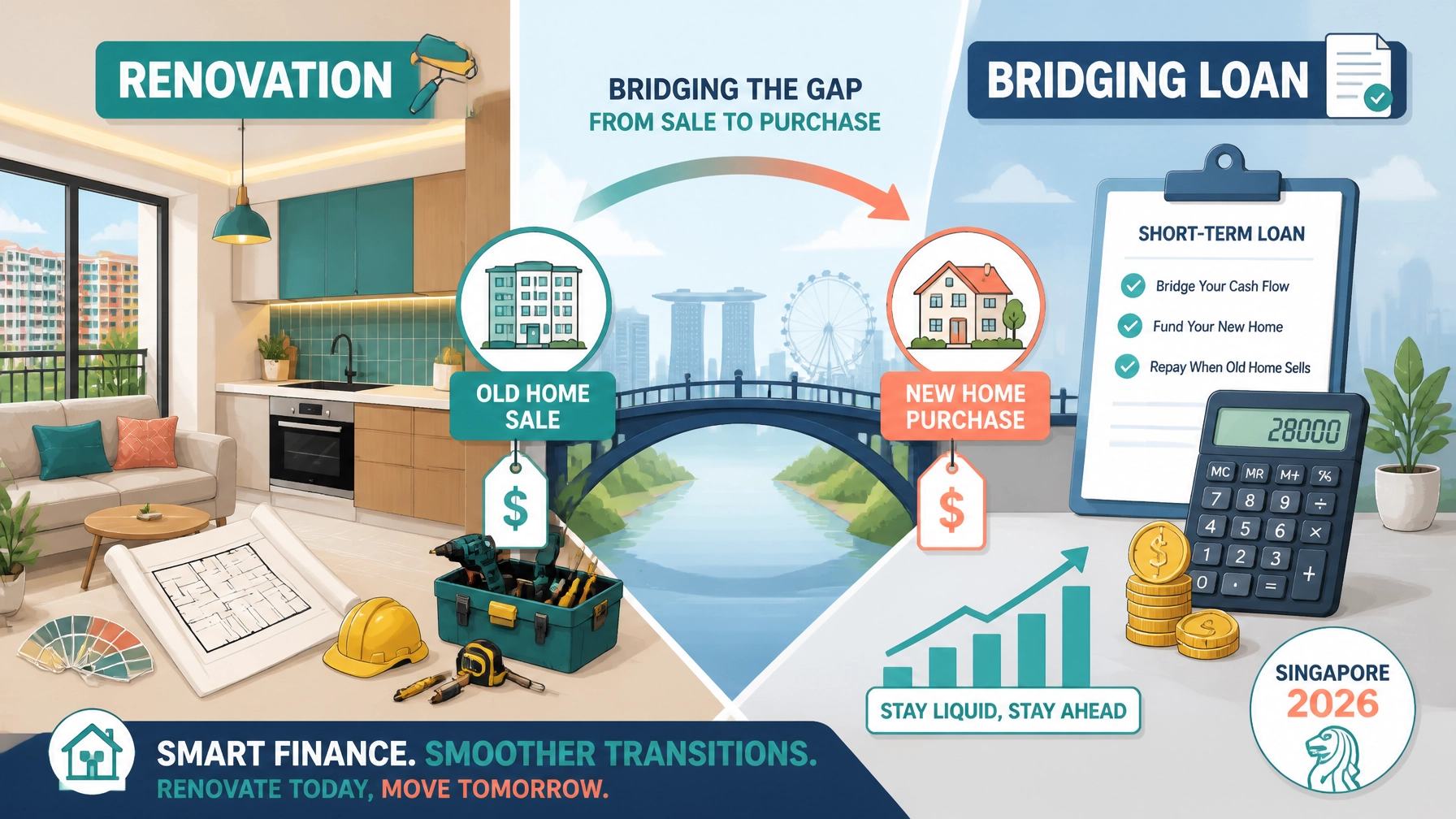
When it comes to buying and renovating property in Singapore, the renovation quotation is only half the financial picture. The bigger challenge is managing timing: your sale proceeds may be locked in your existing home while the downpayment, stamp duty, renovation deposit and moving costs for your next property are due now.
That is where a bridging loan may help. But it is not a renovation loan, and treating the two as interchangeable can create a serious cash-flow problem.
Personal loan offers, via SingSaver.
This guide breaks down Singapore renovation costs, bridging loans, renovation financing, MAS affordability rules and practical ways to protect your budget in 2026.
For a useful starting point, 🚀 EXPLORE NEARME.SG’S PROPERTY AND HOME SERVICES DIRECTORY before you shortlist contractors, movers or other local providers.
Renovation and bridging loans solve different problems
A renovation loan helps pay for eligible renovation works such as carpentry, flooring, painting, electrical work and plumbing. It is generally an unsecured loan with a fixed tenure and monthly instalments.
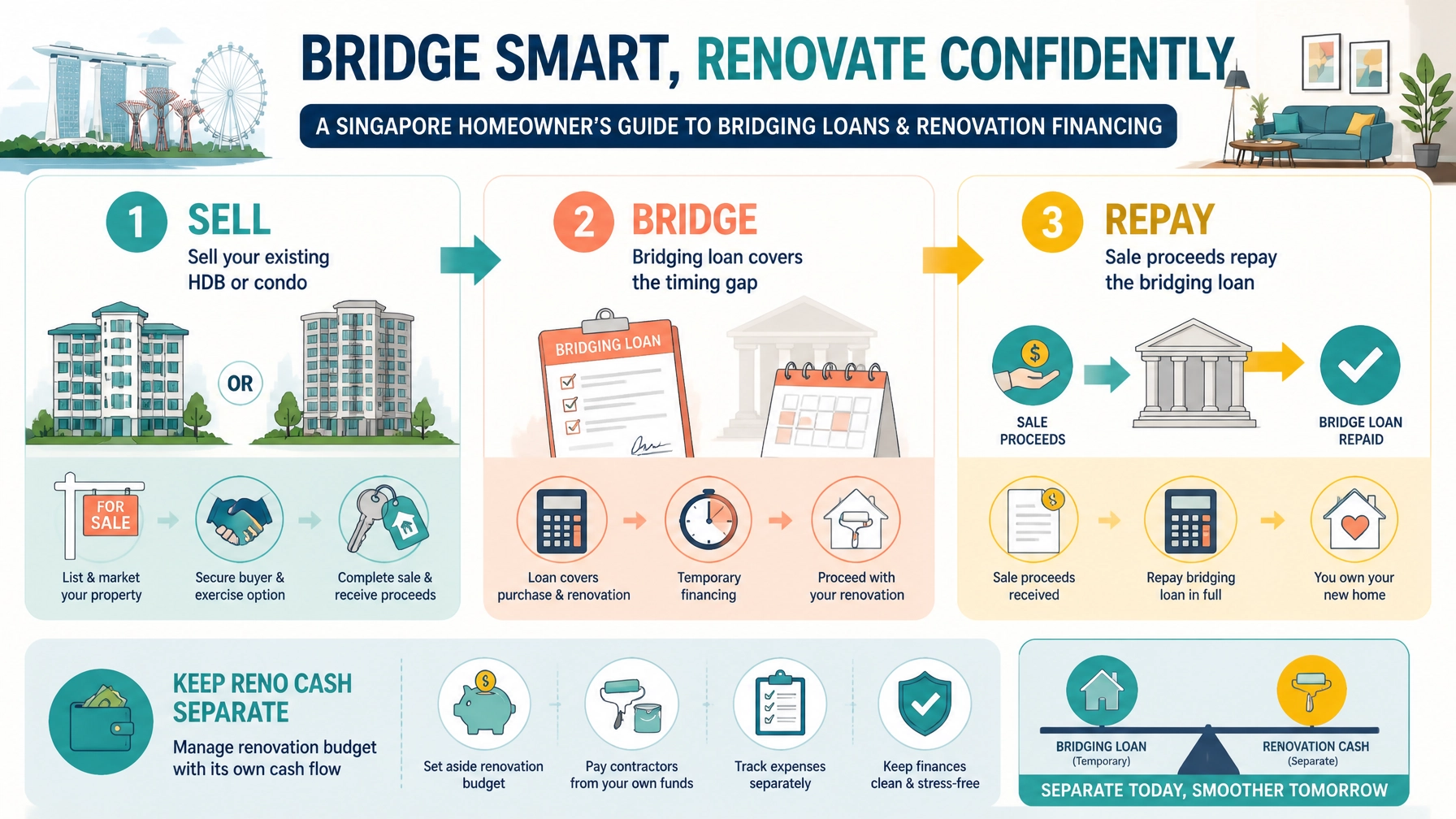
A bridging loan, on the other hand, is a short-term financing facility designed to cover the timing gap between:
-
Buying your next property; and
-
Receiving the net sale proceeds from your existing property.
For example, you may have sold your existing HDB flat but have not yet received the sale proceeds. At the same time, you need to complete the purchase of a private condominium and pay the required upfront costs. A bank may consider a bridging facility, subject to its assessment and documentation, to cover part of that temporary shortfall.
The key distinction is simple:
A bridging loan supports a property transaction. A renovation loan supports renovation works.
Do not assume your bridging facility can fund your renovation. Ask the lender exactly what the facility covers, how interest is calculated and when repayment begins.
Singapore renovation costs in 2026
Let’s talk numbers. A full renovation in Singapore can cost approximately S$25,000 to S$90,000 for many HDB projects, while larger resale condominiums and landed properties can move well into six figures.
Your actual cost depends on the amount of hacking, built-in carpentry, rewiring, bathroom work, material quality and the number of design changes.
| Property type | Typical 2026 planning range | Common cost drivers |
|---|---|---|
| 3-room BTO | S$25,000–S$45,000 | Carpentry, lighting, painting and furnishings |
| 4-room BTO | S$35,000–S$60,000 | Kitchen, wardrobes, flooring and electrical points |
| 5-room BTO | S$45,000–S$80,000 | Larger carpentry scope and additional storage |
| 3-room resale HDB | S$45,000–S$70,000 | Hacking, rewiring, plumbing and bathroom works |
| 4-room resale HDB | S$60,000–S$95,000 | Full-home overhaul, wet works and custom carpentry |
| Mass-market resale condo | S$80,000–S$180,000+ | Premium finishes, bathrooms and extensive built-ins |
| Landed property | S$120,000–S$300,000+ | Structural, façade, electrical and major wet works |
These are planning ranges, not fixed quotations. Older resale flats in areas such as Ang Mo Kio, Bishan, Tampines and Queenstown may require additional electrical or plumbing work after hacking reveals the condition behind the walls.
A new BTO usually falls toward the lower end because some basic finishes may already be provided. A resale flat can be more expensive even when its floor area is similar because you are paying for demolition and replacement before the attractive design work begins.
For a deeper budgeting breakdown, 🔨 READ NEARME.SG’S 2026 SINGAPORE HOME RENOVATION GUIDE NOW.
A quick renovation budget calculator
Use this simple formula before requesting quotations:
Estimated renovation budget = floor area × planning rate + 10% to 15% contingency
Worked example: 4-room resale HDB flat
Assume your flat is approximately 1,000 sq ft and you expect a moderate renovation scope:
-
Planning rate: S$70 per sq ft
-
Base estimate: 1,000 × S$70 = S$70,000
-
10% contingency: S$7,000
-
Safer working budget: S$77,000
The contingency is not spare money for decorative upgrades. Keep it for hidden pipe damage, electrical rectification, additional hacking, replacement of unsuitable fittings, delay-related storage and approved variation orders.
If the renovation quote already consumes every dollar you have, the project is too expensive.
How bridging loans work for property upgraders
A bridging loan is most relevant when you are selling one property and buying another but the transaction timelines do not align.
A typical sequence looks like this:
-
You secure the next property and calculate the required downpayment, stamp duty and legal costs.
-
Your existing home is sold, but completion has not taken place.
-
The lender assesses your expected net sale proceeds, existing mortgage, CPF refund obligations and new property loan.
-
If approved, the bridging loan provides temporary liquidity.
-
The facility is repaid when the sale proceeds from your existing property are received.
The bank will not simply look at your property’s headline selling price. It may consider:
-
Outstanding mortgage balance
-
CPF funds that must be refunded after sale
-
Sale and legal expenses
-
Confirmed sale documentation
-
Completion dates
-
The new property’s purchase price
-
Your income and other debts
-
Whether the new long-term mortgage is affordable
Illustrative cash-flow example
Imagine the following:
-
Expected selling price of existing home: S$1,300,000
-
Outstanding mortgage: S$500,000
-
Estimated CPF refund: S$250,000
-
Selling and transaction costs: S$20,000
-
Approximate net sale proceeds: S$530,000
Your new property costs S$1,600,000. A 25% upfront requirement would be S$400,000, before stamp duty, legal fees and other costs. Although the eventual sale proceeds may be sufficient, you may still face a timing gap if the money arrives later.
A bridging loan could potentially cover an approved portion of that gap. However, the final amount, interest and repayment structure depend on your lender. Get the numbers in writing before exercising the Option to Purchase.
How much can you borrow under Singapore property rules?
Three rules matter most: LTV, TDSR and MSR.
Loan-to-Value, or LTV
For bank housing loans, the current framework described by MAS’s official LTV guidance generally provides:
| Outstanding housing loans | Standard LTV | Lower LTV where tenure or age conditions apply |
|---|---|---|
| None | 75% | 55% |
| One | 45% | 25% |
| Two or more | 35% | 15% |
The lower limit can apply when the loan tenure exceeds the relevant threshold or extends beyond age 65. A longer tenure may reduce your monthly instalment, but it can increase your total interest and reduce borrowing capacity.
Total Debt Servicing Ratio, or TDSR
Your TDSR measures total monthly debt repayments against gross monthly income. Under the current framework, the threshold is 55%.
It can include:
-
Existing and new mortgages
-
Car loans
-
Personal loans
-
Credit-card instalments
-
Renovation loans
-
Other assessed debt commitments
Read the MAS MSR and TDSR rules and use the MoneySense property affordability guide before committing to a new purchase.
Mortgage Servicing Ratio, or MSR
For HDB flats and qualifying Executive Condominiums, MSR generally limits mortgage repayments to 30% of gross monthly income.
This is separate from TDSR. Meeting one does not automatically mean you meet the other.
Should you use a renovation loan or cash?
Many bank renovation loans are capped around S$30,000, although the exact limit, interest rate, eligible expenses and tenure vary by lender.
A renovation loan is designed for situations such as:
-
Your project has a defined scope
-
You want fixed monthly repayments
-
You have enough cash for the remaining renovation cost
-
You want to avoid using high-interest credit-card debt
A personal loan may offer a higher quantum, but it can cost more. It should not be used casually to cover an uncontrolled renovation budget.
Your CPF savings generally cannot be used as a general renovation fund. CPF may be relevant to eligible property purchase costs, but renovation expenses usually require cash or approved borrowing.
Most importantly, protect your emergency fund. Do not spend every dollar on marble-look tiles and full-height carpentry while leaving nothing for mortgage instalments, medical expenses or temporary accommodation.
The safest way to coordinate purchase, bridging and renovation
Use this sequence:
-
Confirm your maximum property budget using your income, existing debts and available cash.
-
Calculate the net sale proceeds, not just your expected selling price.
-
Ask the lender for a written bridging-loan estimate and repayment timeline.
-
Set aside stamp duty, legal fees and moving costs before allocating money to renovation.
-
Obtain three itemised renovation quotations with matching scopes.
-
Keep 10% to 15% contingency for changes and defects.
-
Separate renovation borrowing from the bridging facility unless the lender explicitly confirms otherwise.
-
Delay non-essential upgrades such as feature walls, premium appliances and extensive custom storage if cash flow is tight.
Before signing, check HDB’s official renovation guidelines. HDB rules cover building, window, electrical, air-conditioning, plumbing and gas works. For condominiums, obtain MCST approval and check renovation deposits, working hours, lift protection and contractor insurance requirements.
Contractor checks before you sign
A low quotation is not automatically a good deal. Compare:
-
Hacking and disposal charges
-
Number of electrical and lighting points
-
Waterproofing system and warranty
-
Tile, laminate and hardware specifications
-
Carpentry internal fittings
-
Appliance installation
-
Painting coats and touch-ups
-
Project supervision
-
Defects liability period
-
Payment milestones
-
Variation-order process
You can check the HDB Directory of Renovation Contractors and review CaseTrust accreditation information.
Avoid contractors who demand most of the payment upfront, refuse to itemise materials or pressure you to sign immediately. Every design change should be documented with a revised price and written approval.
For contractor discovery and local service comparisons, 🔎 COMPARE RELIABLE SINGAPORE SERVICE PROVIDERS ON NEARME.SG.
Final checklist before you commit
Before taking a bridging or renovation loan, confirm that you can answer “yes” to these questions:
-
Do you know your true net sale proceeds?
-
Is the new mortgage affordable under TDSR and MSR?
-
Is the bridging loan repayment linked to a realistic sale completion date?
-
Have you budgeted for stamp duty and legal costs?
-
Is your renovation quotation itemised?
-
Do you have a 10% to 15% contingency?
-
Can you still maintain six months of essential expenses?
-
Are all permits and approvals confirmed?
-
Are payment milestones tied to completed work?
A beautiful renovation should improve your home: not turn it into a monthly financial emergency. When you separate property financing from renovation financing, calculate the timing gap honestly and keep a meaningful cash buffer, you give yourself the strongest chance of upgrading with confidence.
For more property finance planning, 💡 Read our guide to refinancing a home loan.
Disclosure: NearMe.SG may earn a commission from some links on this page. This does not affect our editorial recommendations.
Personal loan offers, via SingSaver.
RELATED POSTS
View all

Affordable landed homes under $3.5M? 2025 Guide
August 9, 2025 | by nearme.sg
Skye at Holland: Launch Results, Unit Mix and Facts
August 3, 2025 | by nearme.sg