


The Ultimate New Homeowner Checklist: Moving In & Getting Settled (Singapore 2026)
August 10, 2026 | by nearme.sg


Becoming a new homeowner in Singapore is exciting — collecting your keys is only the beginning. The first 30 days can feel like a whirlwind of appointments, paperwork, contractors, deliveries and small decisions that quickly add up.
What should you do first? When should you open your SP Services account? How soon must you report BTO defects? And what happens if you forget to update your NRIC address?
📥 Free New Homeowner Checklist PDF Download
Get a printable checklist to track utilities, renovation, and moving tasks.
Looking for the best deal on this? You can compare cost per application on SingSaver.
Disclosure: NearMe.SG may earn a commission from some links on this page. This does not affect our editorial recommendations.
This practical new homeowner Singapore checklist takes you from two to four weeks before move-in through your first month at home: whether you are moving into an HDB BTO, resale flat or condominium.
Important: Rules and procedures can differ between HDB estates, Town Councils, condominium MCSTs and developers. Always confirm the latest requirements with the relevant authority or building management.
Your First 30 Days at a Glance
| Timing | Priority tasks |
|---|---|
| 2–4 weeks before move-in | Open SP Services account, book lift slot, arrange movers, notify banks and insurers |
| Key collection day | Inspect the property, photograph defects, confirm keys and documents |
| First week | Change locks, activate utilities, install internet, arrange insurance and essential appliances |
| Within 28 days | Update your residential address through ICA’s Singpass e-Service |
| By Day 30 | Complete mail redirection, review defects, organise warranties and meet neighbours |
If you are still comparing contractors or movers, start with the 🏠 Explore NearMe.SG’s Home Services Directory and find local help for your move.
1. Before Move-In: Start 2–4 Weeks Early
The smoothest move-ins are planned before the first box enters the lift. Begin with the administrative tasks that can delay everything else.
Create your SP Services account
Set up your electricity, water and gas account through the SP Group utilities portal or the SP app. You will generally need:
-
NRIC, FIN or passport
-
Proof of ownership or tenancy
-
Your new address
-
Preferred account start date
-
Payment and deposit details
Open the account early: ideally one to two weeks before move-in: so utilities are available for cleaning, renovation checks and appliance installation. If the supply is not active, you may also need to book a turn-on appointment.
Book your lift slot
For an HDB flat, contact your Town Council, managing agent or estate office to ask about:
-
Lift padding requirements
-
Available moving time slots
-
Refundable deposits
-
Loading and unloading rules
-
Protection for corridors and common areas
For a condominium, contact the MCST or managing agent. Condo buildings often have stricter booking windows, loading-bay rules and move-in deposits.
Do not book movers first and hope the lift will be available later. Popular weekend slots disappear quickly: especially at the end of the month.
Confirm your mover and parking arrangements
Ask your moving company for the truck’s exact dimensions and registration number. Then check whether your estate requires:
-
A temporary parking permit
-
Loading-bay registration
-
Security clearance
-
A booking for the car park ramp
-
A specific moving route or time window
If the truck cannot enter the car park, your movers may need to transfer items from the roadside. That means more time, more handling and potentially higher charges.
Notify banks, LTA and insurers
Update your new address with organisations that depend on accurate correspondence:
-
Banks and credit card providers
-
Insurance companies
-
CPF-related correspondence, where applicable
-
LTA and vehicle-related records
-
Employers and payroll departments
-
Schools, clinics and subscription services
Updating your address early helps prevent sensitive documents, renewal notices and vehicle-related letters from going to your previous home.
2. Key Collection Day: Inspect Before You Renovate
Key collection day is exciting, but do not rush straight to furniture shopping. Before renovation, hacking, drilling or moving bulky items into the unit, complete a careful inspection.
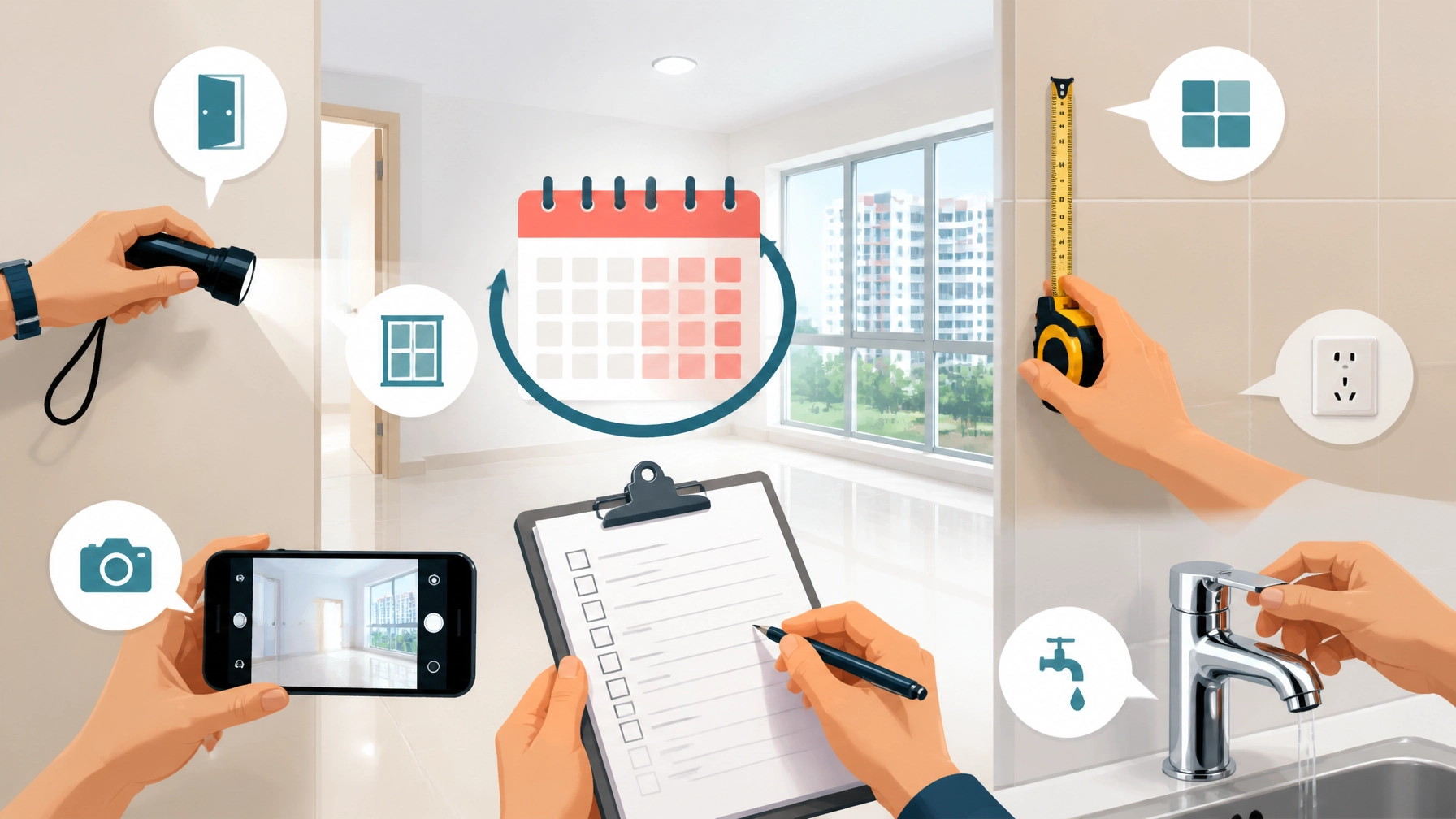
Bring a simple inspection kit
Pack:
-
Phone with a fully charged battery
-
Charger or power bank
-
Torch
-
Measuring tape
-
Small bottle or cup of water
-
Two-pin and three-pin socket tester, if available
-
Painter’s tape and marker
-
Notebook or digital checklist
Take wide-angle photos of every room, followed by close-ups of individual defects. Include the date in your photo records where possible.
Check these areas carefully
Inspect:
-
Walls and ceilings for cracks, stains or uneven paint
-
Floor and wall tiles for chips, cracks or hollow-sounding areas
-
Doors, windows, gates and locks
-
Water taps, toilets, floor traps and under-sink areas
-
Power points, switches and lighting points
-
Kitchen fittings and bathroom fixtures
-
Water pressure and drainage
-
Air-conditioning ledges, windows and service areas
-
Items promised in your sale or handover documents
For a resale flat or condominium, also check whether existing appliances, built-ins and fixtures match the inventory list agreed with the seller.
Report BTO defects promptly
For a new BTO flat, use the first 30 days as your practical defect-reporting target. Inspect and submit your initial list as early as possible: preferably before renovation begins. HDB’s official framework provides a 12-month Defects Liability Period from key collection for eligible defects, but waiting creates avoidable problems, especially if renovation conceals the issue.
Submit defects through HDB’s official rectification process, or follow instructions from your estate’s Building Service Centre.
Keep:
-
A numbered defect list
-
Photos and videos
-
Submission confirmations
-
Follow-up dates
-
Records of completed rectification
Do not assume a contractor will automatically identify HDB defects for you. Your inspection should happen before hacking, flooring, carpentry or painting changes the original condition.
3. The First Week: Secure, Connect and Insure Your Home
Once the defects are documented, focus on making the home safe and functional.
Change exterior locks and access codes
Change the main door lock, gate lock and any digital-lock access codes. This is particularly important for resale homes, where previous owners, tenants, contractors or domestic workers may still have spare keys.
Keep the original keys in a labelled envelope. If you install a digital lock, retain the mechanical override key and understand how to use it before the batteries run low.
Install essential utilities
Before moving in fully, test:
-
Electricity at every socket
-
Water pressure in kitchens and bathrooms
-
Water heaters
-
Gas appliances, if applicable
-
Internet points
-
Doorbells and intercoms
-
Smoke or safety devices
Use a qualified technician for gas, electrical and water-heater work. For renovation, confirm whether your contractor needs an HDB permit before work starts. HDB requires owners to engage the appropriate registered contractor for works that need approval; check the latest HDB renovation permit requirements before hacking, replacing flooring or altering walls.
For help finding home improvement providers, 🔧 Browse NearMe.SG’s Home Improvement Directory before you hire.
Set up broadband early
Internet installation appointments can take several days, particularly during peak moving periods. Arrange broadband before your move if you work from home, use smart-home devices or need internet access for security cameras.
Place the router where coverage is practical: not hidden inside a metal cabinet or behind thick furniture. Test Wi-Fi in bedrooms, the study and the living room before deciding whether you need a mesh system.
Arrange home insurance
For HDB owners, fire insurance is required under applicable HDB arrangements, particularly where an HDB loan is involved. Fire insurance generally covers reinstatement of structural fixtures: not all of your furniture, renovation or personal belongings.
You may also want separate home contents or home protection insurance covering:
-
Furniture and appliances
-
Renovation costs
-
Personal belongings
-
Accidental damage
-
Home contents theft
-
Public liability
Read exclusions carefully. A low premium is not useful if it excludes the items you actually need to protect.
4. Settling In: Complete Your Official and Neighbourhood Admin
The home may look settled, but several important tasks remain.
Update your NRIC residential address within 28 days
Singapore Citizens and Permanent Residents who hold an NRIC must report a change of residential address within 28 days of moving. Use ICA’s official change-of-address e-Service with Singpass.
The process may involve a PIN mailed to your new address. Do not leave this until the final day: mail delays or verification issues can create unnecessary stress.
After updating your NRIC address, manually check your bank, insurance, employer, telecommunications and subscription records as well. Not every private organisation updates automatically.
Redirect your mail
Arrange mail redirection with SingPost if you are moving from another Singapore address. Also update senders individually for important correspondence, including:
-
Banks
-
Insurers
-
Government agencies
-
Medical providers
-
Schools
-
Online retailers
-
Utilities and telecom companies
Meet your neighbours
A quick introduction can make condominium and HDB living much easier. Learn:
-
Where to dispose of bulky items
-
How recycling works in your block
-
Which areas are shared facilities
-
The correct channel for maintenance issues
-
Whether there are estate notices or resident groups
Being friendly from the beginning also helps when you need to coordinate renovation noise, deliveries or temporary corridor access.
5. Common New Homeowner Mistakes to Avoid
Mistake 1: Renovating before recording defects
Once tiles are hacked or cabinets are installed, it becomes much harder to prove whether an issue existed at handover.
Mistake 2: Forgetting the lift booking
A moving truck and a full apartment of furniture are useless if management does not allow the move at your chosen time.
Mistake 3: Assuming the mover handles parking
Your mover may advise you, but parking permissions usually remain your responsibility. Confirm this with the Town Council, MCST or managing agent.
Mistake 4: Buying everything immediately
You do not need to fill every room in the first week. Live in the space, measure carefully and identify what you actually need. This prevents expensive furniture mistakes.
Mistake 5: Losing documents and warranties
Create one digital folder and one physical folder for:
-
Key collection documents
-
HDB or sale documents
-
Insurance policies
-
Renovation contracts
-
Appliance warranties
-
Defect submissions
-
Utility account details
-
Moving invoices
Your First-Month Printable Checklist
-
[ ] Open SP Services account
-
[ ] Book HDB Town Council or condo MCST lift slot
-
[ ] Confirm moving truck access and parking
-
[ ] Notify banks, LTA, insurers and employer
-
[ ] Inspect the home on key collection day
-
[ ] Photograph and submit BTO defects
-
[ ] Change exterior locks and digital access codes
-
[ ] Activate utilities and test essential systems
-
[ ] Arrange broadband installation
-
[ ] Purchase or confirm fire and home insurance
-
[ ] Update NRIC address through Singpass within 28 days
-
[ ] Redirect mail and update private organisations
-
[ ] Register warranties and store key documents
-
[ ] Introduce yourself to neighbours
Moving into a new home in Singapore involves plenty of details, but the process becomes manageable when you tackle it in the right order. Secure the paperwork first, inspect before renovating, book shared facilities early and complete your address and insurance tasks within the first month.
Once those foundations are in place, you can stop chasing deadlines and start enjoying the best part: turning your new address into a home.
Need help with the next step? 📦 Find local moving, home-living and renovation services on NearMe.SG and continue building your new homeowner checklist with trusted local options.
📥 Free New Homeowner Checklist PDF Download
Get a printable checklist to track utilities, renovation, and moving tasks.
Looking for the best deal on this? You can compare cost per application on SingSaver.
Disclosure: NearMe.SG may earn a commission from some links on this page. This does not affect our editorial recommendations.
RELATED POSTS
View all


Singapore Property in 2026: The $3,000 PSF ‘New Normal’ & How to Invest Smartly
February 14, 2026 | by nearme.sg

P1 Registration Shake-Up 2026: What the New Phase 2C Rules Mean for Singapore Property Prices
September 22, 2026 | by nearme.sg

Canberra Crescent Residences: Expert Guide & Investment Insights
August 2, 2025 | by nearme.sg