
Patting a Child’s Head Got an Elderly Man Shoved: What Singapore’s “Asian Values” Debate Is Really About
August 18, 2026 | by nearme.sg
📖 More Singapore insights
Explore the NearMe.SG Blog for thoughtful perspectives on Singapore life, culture and community issues.

At the heart of the Singapore culture and Asian values conversation, few incidents have triggered as much uncomfortable reflection as the reported confrontation at Roxy Square on 15 August 2026.
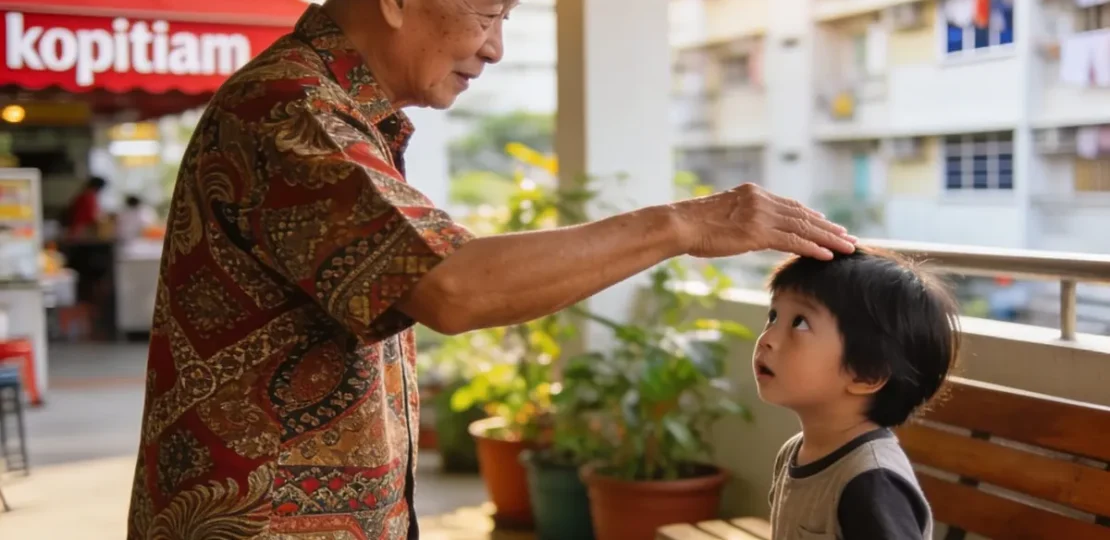
A 73-year-old man, identified in media reports as Yeo Song Khoon, was allegedly shoved to the ground after patting a young girl on the head at a coffee shop. The Singapore Police Force has identified a 40-year-old man in connection with the case, and investigations are ongoing.
That distinction matters. A viral video may show a moment, but it does not always show the full context. Police have advised the public not to speculate while the facts are established. Keep that principle in mind as you consider the larger conversation.
Because this story is not only about one physical confrontation. It is also about how you balance respect for elders, parental responsibility, personal boundaries, public etiquette in Singapore and the kind of kindness Singapore residents want to see in everyday life.
Important note: This article discusses the cultural issues raised by public reporting. It does not determine legal responsibility or make findings about anyone involved in the incident.
For more thoughtful local perspectives on Singapore life, culture and practical community issues, you can also 🚀 Explore the NearMe.SG Blog for more Singapore insights.
1. What reportedly happened at Roxy Square?
Based on reports by Mothership and VnExpress, the incident took place at a coffee shop at Roxy Square, 50 East Coast Road, at around 4.40pm.
Yeo, who reportedly has difficulty walking, was moving through the coffee shop when he patted the head of a young girl. Reports said he described the child as adorable. The child’s father then confronted him, and Yeo was pulled or pushed to the ground.
He later experienced pain and swelling and went to hospital for a medical check-up. His family shared CCTV footage online and made a police report. Media reports also said that the father subsequently apologised and offered to buy Yeo a drink, which he declined.
There are several layers to this account:
-
An elderly person was reportedly injured in a busy public setting.
-
A parent may have felt the need to protect a young child.
-
The child’s personal boundaries and comfort are relevant.
-
A physical response can escalate a situation within seconds.
-
The public reaction has extended well beyond the people directly involved.
The safest conclusion at this stage is simple: wait for verified facts, reject online speculation and focus on what the incident can teach you about handling conflict.
2. Respect for elders versus personal boundaries
This is where the national debate becomes complicated.
On one side, many Singaporeans instinctively feel that pushing an elderly man is unacceptable. That reaction comes from a deeply rooted expectation of intergenerational respect. Older people are traditionally addressed politely, given priority and treated with patience, especially in a crowded coffee shop, market or neighbourhood setting.
On the other side, parents have legitimate concerns about strangers touching their children. A child’s body is not public property. Even an apparently friendly gesture may make a child uncomfortable, or worry a parent who does not know the person.
Both principles can exist at the same time:
-
You should respect an elderly person.
-
You should respect a child’s personal space.
-
You should not use violence to settle a verbal or social disagreement.
-
You should communicate clearly before anger takes over.
That is the real lesson. Respect is not a competition in which one person’s dignity cancels out another person’s boundaries.
A parent can say, “Please don’t touch my child.” An older person can respond with an apology. A bystander can create space. A staff member can help calm the situation. These are small actions, but they prevent a tense encounter from becoming an injury.
3. Where Singapore’s “Asian values” came from
The phrase “Asian values” is often used casually, but it has a specific history in Singapore.
It is commonly associated with values such as:
-
Filial piety and care for parents
-
Respect for elders and authority
-
Family responsibility
-
Hard work and thrift
-
Discipline and education
-
Social harmony
-
Putting community interests alongside individual interests
Singapore’s modern identity was shaped by migration, multiculturalism, rapid industrialisation and strong public institutions. Confucian ideas influenced many Chinese families, while Malay, Indian and other Asian traditions contributed their own forms of respect, family duty and community responsibility.
The result is not one single Asian culture. Singapore is a shared society made up of different histories and practices.
Still, some themes are recognisable. You may see them when children greet grandparents respectfully, when neighbours share food, or when families organise care for ageing parents. You may also see them in the expectation that people queue properly, keep noise under control and avoid making public spaces uncomfortable for others.
The Cultural Atlas overview of Singaporean culture describes several of these themes, including family obligation, hierarchy and social harmony.
What does “kampung spirit” mean today?
The kampung spirit refers to the neighbourliness associated with close-knit village life: people knowing one another, sharing resources and looking out for children and older residents.
Singapore has transformed dramatically from kampungs into a dense, high-rise city. Yet the ideal remains powerful. You still see it in residents helping during emergencies, checking on vulnerable neighbours and organising community activities in HDB estates.

However, kampung spirit should not mean assuming everyone welcomes familiarity. True community spirit includes asking first, respecting differences and understanding that strangers may have different comfort levels.
In other words, community care is not permission to ignore personal boundaries.
4. Singapore culture is changing, and that is not necessarily bad
Singapore’s social norms are evolving quickly.
Younger Singaporeans are more likely to discuss consent, mental health, personal autonomy and the right to challenge authority. Parents are also increasingly conscious that children should learn how to say “no” politely and recognise unsafe behaviour.
At the same time, older residents may come from a social environment where adults freely greeted, touched or spoke to children in the neighbourhood. A friendly pat on the head might once have been viewed as ordinary affection rather than an intrusion.
Neither generation should be dismissed.
The better approach is to update traditional values rather than abandon them. Respect for elders can remain important while becoming mutual rather than one-directional. Children can learn to greet seniors courteously while also being told that they can step away from unwanted contact. Parents can protect their children without treating every awkward interaction as a threat.

This is especially important in a city where people from different cultures, ages and backgrounds share the same lifts, buses, hawker centres, schools and playgrounds.
Modern Singapore etiquette should therefore include four questions:
-
Did I ask before entering someone’s personal space?
-
Did I explain my concern without humiliating the other person?
-
Did I give the other person a chance to correct their behaviour?
-
Did I protect safety without escalating unnecessarily?
That is a more resilient form of Asian values, one based on responsibility, not automatic deference.
5. A practical de-escalation checklist for public conflicts
If you witness a similar situation, your first responsibility is safety. Do not put yourself or another person at unnecessary risk.
The PAUSE method
| Step | What you can do |
|---|---|
| P — Pause | Take a breath and avoid shouting, insulting or making sudden movements. |
| A — Allow space | Move children and vulnerable people away from the immediate tension. |
| U — Use clear words | Say, “Please give them some space,” or “Let’s keep this calm.” |
| S — Seek help | Alert coffee-shop staff, security or the police if there is danger or injury. |
| E — Examine the aftermath | Check whether anyone needs medical attention and share accurate information with authorities. |
If you are a parent
You can set a firm boundary without provoking a confrontation:
“Please don’t touch my child. We are teaching her to ask before physical contact.”
Then move your child closer to you. If the person apologises, let the interaction end unless there is an immediate safety concern.
If you are an older person
A child may not be comfortable with a pat, hug or playful touch, even when your intention is kind. A wave, smile or verbal compliment is usually safer. Try saying, “Hello, what a lovely smile,” instead.
If you are a bystander
Do not crowd around, film for entertainment or spread unverified claims online. If it is safe, use a calm sentence, call staff and note what you personally observed. If someone is injured, call 995 for an ambulance or 999 for police assistance.
For more ways to find dependable local support and essential services, 📍 Visit NearMe.SG to discover trusted Singapore service providers.
6. Keeping the warmth without losing safety
The Roxy Square incident has struck a nerve because Singaporeans still care about how generations treat one another. You want children to grow up respectful. You want seniors to feel safe. You want parents to protect their families. You want public places to remain welcoming rather than tense.
Those goals are not contradictory.
The strongest version of Singapore culture and Asian values is not blind obedience, public shaming or the idea that age gives anyone unlimited authority. It is the willingness to protect dignity on all sides.
That means respecting elders without excusing aggression. It means protecting children without assuming bad intentions. It means using boundaries as a form of care, not hostility. It means reviving the kampung spirit Singapore once valued: but with consent, patience and mutual accountability.
As Singapore becomes more diverse and more open about individual rights, kindness will need to become more deliberate. A smile, a greeting, a calm explanation and a little extra patience can still bridge generations.
The opportunity is right in front of you: keep the warmth of tradition, add the clarity of modern boundaries and make everyday public life safer for everyone. That is not the end of Asian values. It is how they grow.
📖 Thoughtful perspectives on Singapore life
Find more articles on culture, community and practical living at the NearMe.SG Blog.
Disclosure: NearMe.SG may earn a commission from some links on this page. This does not affect our editorial recommendations.
Compare on SingSaver →
RELATED POSTS
View all