


Refinancing a Home Loan in Singapore (2026)
August 2, 2026 | by nearme.sg Editorial Team
Last updated
Refinancing a home loan in Singapore means moving your loan to a different bank. Repricing means switching to a new package with your current bank. Either can change your interest rate, but there are costs to weigh. These include legal and valuation fees when you switch banks, an early redemption fee of around 1.5% of the outstanding loan if you leave during a lock-in, and possible clawbacks of past subsidies. Owner-occupiers who refinance aren’t subject to the MAS TDSR threshold. Here’s how it works, using what MAS, CPF Board and the banks publish, as checked on 25 October 2026.
This article is general information, not financial advice. It doesn’t take your personal circumstances into account, and we aren’t a licensed financial adviser. Check the terms of your own loan and any offer with the bank before you decide.
Repricing vs refinancing a home loan in Singapore
- Repricing: you stay with the same bank and move to a different package. At DBS, for example, there’s no legal or valuation fee to reprice, but there’s an administration fee of about S$800. Approval takes about 4 to 5 weeks, and you can apply up to 4 months before your commitment period ends (DBS repricing page).
- Refinancing: you take a new loan with another bank to repay the old one. DBS estimates legal and valuation fees of S$3,000 and above (for HDB flats) and about 9 to 13 weeks for approval and the notice period. Some banks offer cash rewards or subsidies to offset these costs. DBS, for example, lists cash rewards of up to S$4,000, depending on property type and loan size (DBS refinancing page).
Whether you reprice or refinance, leaving during a lock-in period usually costs an early redemption fee. DBS puts this at approximately 1.5% of the outstanding loan amount.
What refinancing costs
- Lock-in penalty. According to CPF Board, most bank loans have a lock-in of around one to three years. Repaying or refinancing within it incurs a penalty that “could be around 1.5% of the outstanding loan amount”, although terms vary by bank and package.
- Legal and valuation fees. These are charged when you move to a new bank. Some banks subsidise them, sometimes with conditions.
- Clawbacks. If your current bank gave you a legal subsidy or cash rebate, it may claw this back if you repay or refinance within a set period. That period is stated in your Letter of Offer. DBS’s FAQ suggests considering refinancing once both the lock-in and the cash rebate clawback periods have ended.
- Repricing administration fee. DBS charges about S$800, as above.
When to start looking
Check your latest loan statement or banking app for your outstanding balance, current rate, lock-in end date and any clawback period. Because switching banks takes longer than repricing (about 9 to 13 weeks against 4 to 5 weeks at DBS), some homeowners start comparing a few months before the lock-in ends. DBS suggests exploring repricing 3 to 4 months before the lock-in period ends.
Many packages are pegged to the 3-month compounded Singapore Overnight Rate Average (SORA), which changes daily. MAS publishes it on its domestic interest rates page (see also MAS’s SORA explainer). For a floating package, ask the bank for the spread over SORA for each year of the loan, including after the lock-in.
Does TDSR apply when you refinance?
The Total Debt Servicing Ratio (TDSR) limits a borrower’s total monthly debt repayments to 55% of gross monthly income for property loans. For HDB flats and ECs still within their minimum occupation period, the Mortgage Servicing Ratio (MSR) caps property loan repayments at 30% (MAS MSR and TDSR rules).
For refinancing, MAS sets out exemptions:
- Owner-occupied housing loans: the TDSR threshold and MSR limit don’t apply when you refinance.
- Investment property loans: borrowers may refinance above the TDSR threshold if they commit to a debt reduction plan with the bank (repaying at least 3% of the outstanding balance over no more than 3 years) and meet the bank’s credit assessment.
When MAS’s TDSR rules do apply, as for a new property purchase loan, banks must calculate instalments using the higher of a 4% floor or the loan’s “thereafter” rate for residential property (MAS, Calculating TDSR). Each bank still runs its own credit assessment. MAS’s TDSR rules apply to loans applied for on or after 29 June 2013.
Refinancing an HDB loan to a bank loan
According to CPF Board, the HDB concessionary loan rate is currently 2.6% a year and is pegged to the CPF Ordinary Account rate. The OA rate is 2.5% a year from 1 October to 31 December 2026. An HDB loan has no lock-in, so you can refinance it with a bank at any time, subject to the bank’s approval. Once you refinance an HDB loan with a bank, you can’t switch back to an HDB loan. A bank loan can’t be refinanced into an HDB loan.
How to work out your break-even
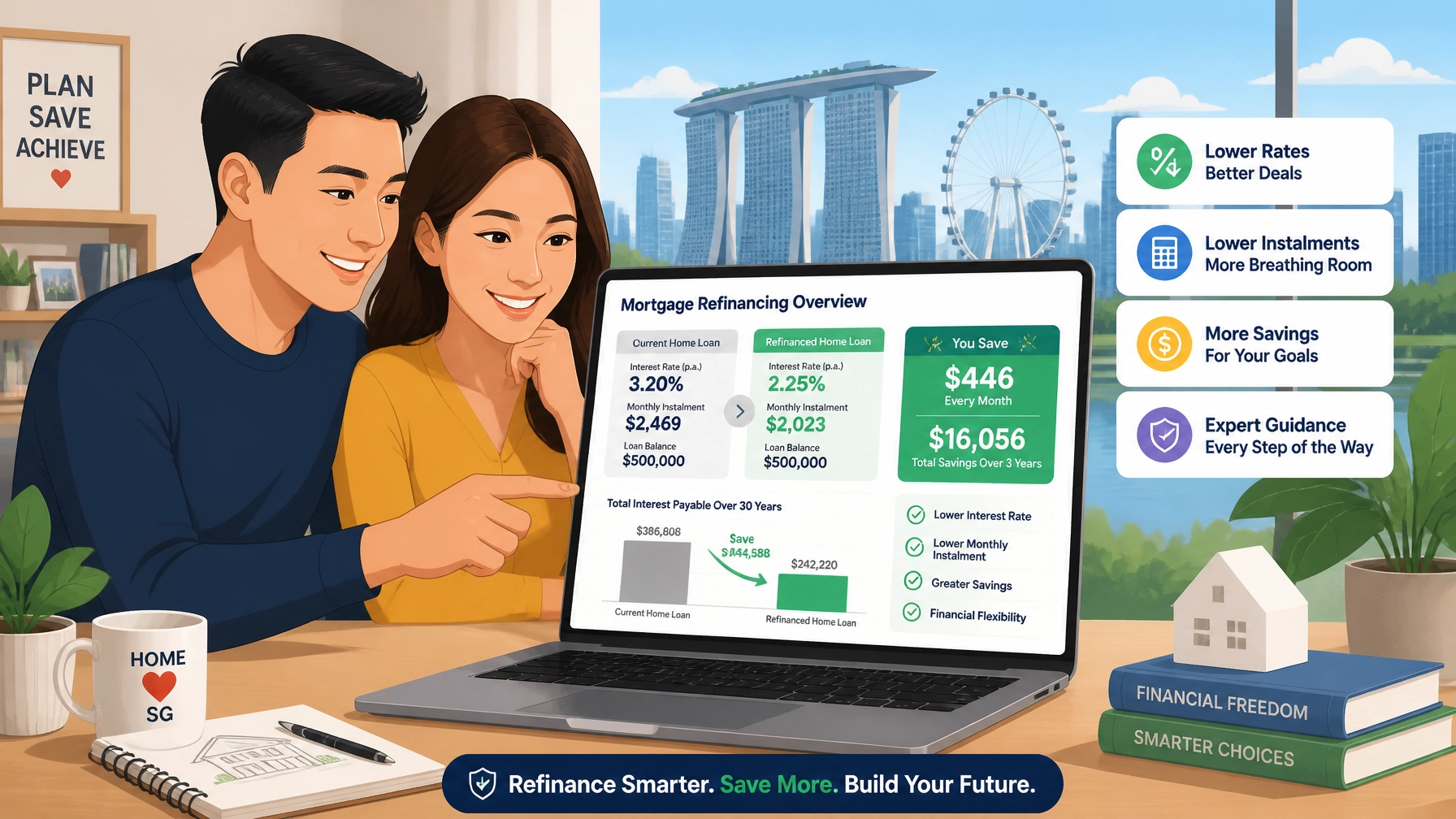
Compare the difference in monthly instalments over the new lock-in period with the total cost of switching. Here’s an illustration with assumed rates, not current offers:
- Outstanding loan S$800,000, 25 years remaining.
- At 3.5% a year, the monthly instalment is about S$4,005. At 3.0% a year, it’s about S$3,794.
- The difference is about S$211 a month, or about S$5,071 over 24 months, before fees.
- Subtract the switching costs: legal and valuation fees (less any bank subsidy), any lock-in penalty and any clawback. Repricing has its own admin fee instead.
Your own figures depend on the rates you’re actually offered, the rate after any lock-in, your remaining tenure and the fees in your offer letter.
Using a mortgage broker
Some homeowners use a mortgage broker to compare packages across banks. If you do, ask how the broker is paid, which banks it works with, and whether it charges you any fee.
Steps to reprice or refinance
- Check your loan details: outstanding balance, current rate, lock-in end date and any clawback period.
- Get your current bank’s repricing offer and quotes from other banks for the same loan amount and tenure.
- Compare the rates for each year of the loan, including after the lock-in, plus fees, subsidies and any conditions.
- Work out the break-even as above, using your actual figures.
- Allow time. Refinancing to another bank involves a valuation, legal work and a notice period, so it takes longer than repricing.
Summary
Repricing keeps your loan with the same bank, usually with lower fees and a shorter process. Refinancing moves it to another bank, with legal and valuation costs that some banks subsidise. Leaving during a lock-in typically costs around 1.5% of the outstanding loan. MAS exempts owner-occupied housing loans from the TDSR threshold when refinancing. An HDB loan can be refinanced to a bank at any time, but not switched back.
FAQ
How much does it cost to refinance a home loan in Singapore?
It depends on the bank and property. DBS, for example, estimates legal and valuation fees of S$3,000 and above for HDB flats when refinancing to another bank, and offers cash rewards of up to S$4,000 depending on loan size. Add any lock-in penalty (around 1.5%) and clawbacks from your current bank.
Do I need to pass TDSR to refinance?
Not for an owner-occupied housing loan. MAS exempts it from the TDSR threshold and MSR limit at refinancing. Investment property loans can be refinanced above the threshold if the borrower commits to a debt reduction plan and meets the bank’s credit assessment.
How early can I reprice?
It varies by bank. DBS allows repricing applications up to 4 months before the commitment period ends. To apply online, the loan balance must be at least S$100,000 with more than 5 years of tenure remaining.
Can I go back to an HDB loan after refinancing to a bank?
No. According to CPF Board, once you refinance an HDB loan with a bank, you can’t switch back to an HDB loan.
Related: renovation and bridging loans in Singapore and HDB resale rules for private property owners (July 2026). For a general checklist, see our Singapore Property Buyer’s Checklist 2026.
RELATED POSTS
View all


Singapore Property in 2026: The $3,000 PSF ‘New Normal’ & How to Invest Smartly
February 14, 2026 | by nearme.sg

Vela Bay at Bayshore Review: Free Expert Guide 2026
February 7, 2026 | by nearme.sg

Freehold Landed Property in Singapore Under S$5M: Free Expert Guide
June 4, 2025 | by nearme.sg