

International Schools in Singapore: Curricula, Fees and Admissions Guide
August 12, 2026 | by nearme.sg
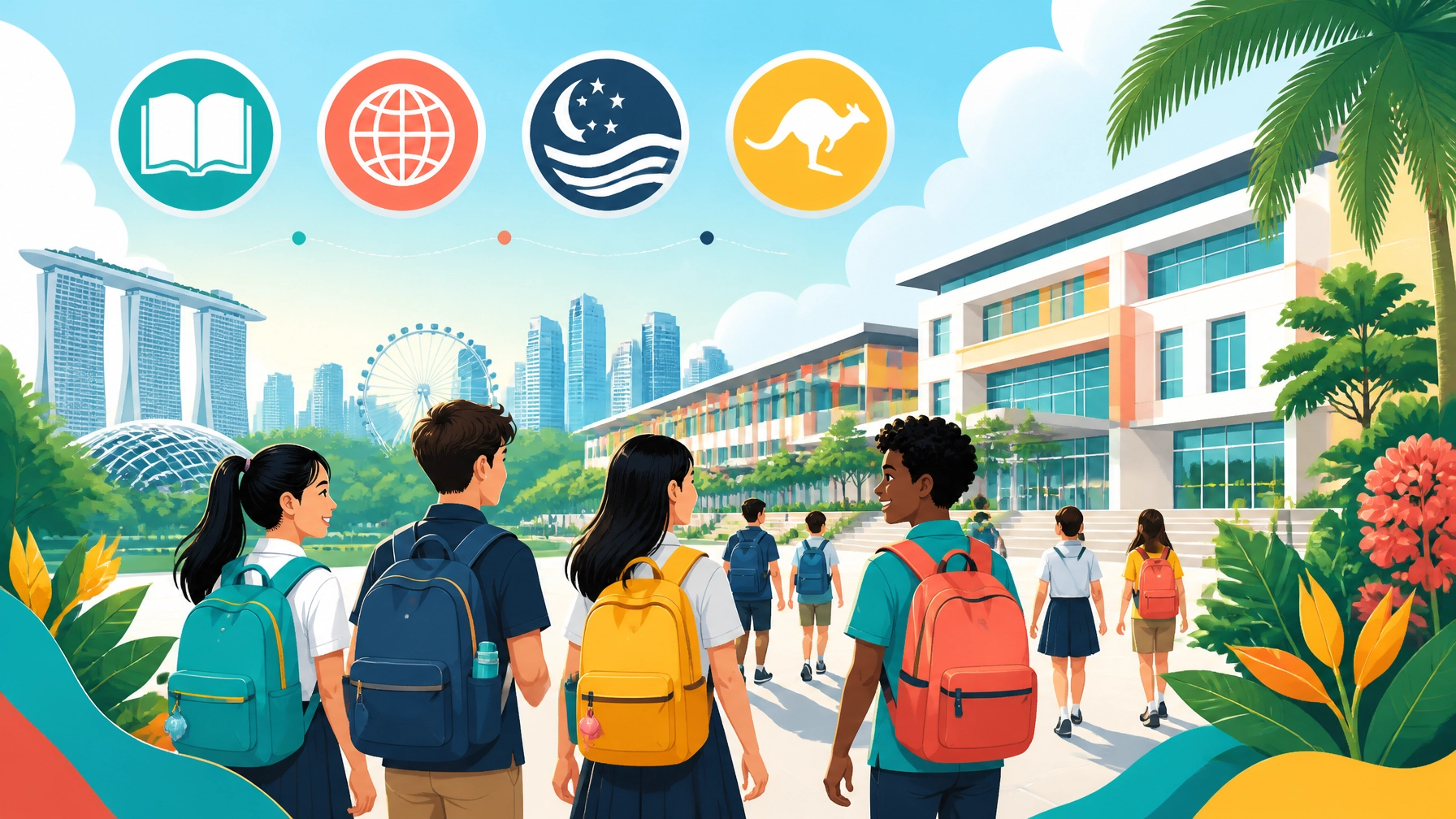
Choosing an international school in Singapore, the hardest part is rarely finding options. Singapore has a dense and varied school market, with IB, British, American, Australian and hybrid pathways spread across the island.
The real challenge is matching the right curriculum, fee structure, location and learning environment to your child.
Whether you are an expatriate family relocating to Singapore or a local family exploring alternatives to the mainstream system, this guide will help you shortlist schools with greater confidence.
👉 Explore more practical Singapore family and relocation insights on NearMe.SG
International school curricula in Singapore

1. International Baccalaureate (IB)
The IB is designed for internationally mobile students and is recognised by universities worldwide. Its programmes include:
-
Primary Years Programme (PYP)
-
Middle Years Programme (MYP)
-
Diploma Programme (DP)
The IB Diploma includes six subject groups, plus Theory of Knowledge, the Extended Essay and Creativity, Activity, Service. It is academically broad and encourages independent research, critical thinking and global perspectives.
You can explore the official IB programme structure for more detail.
Well-known IB and IB-continuum schools include:
-
United World College of South East Asia (UWCSEA)
-
Canadian International School (CIS)
-
ISS International School
-
Australian International School (AIS)
-
Stamford American International School
-
HWA International School
-
One World International School (OWIS)
IB is a strong choice if your family may move between countries or if your child is likely to apply to universities across several education systems.
2. British curriculum
British international schools typically follow the Early Years Foundation Stage, Key Stages, IGCSE and either A-Levels or the IB Diploma in the senior years.
This pathway suits families familiar with the UK system or those considering universities in the United Kingdom, Australia, Singapore or other Commonwealth countries.
Examples include:
-
Tanglin Trust School
-
Dulwich College (Singapore)
-
North London Collegiate School Singapore
-
Dover Court International School
-
The Perse School Singapore
The British system is structured and examination-focused, particularly from IGCSE onwards. It can be a good fit for students who prefer clear subject progression and defined academic milestones.
3. American curriculum
American schools generally use US grade levels, credit systems and continuous assessment. Senior students may have access to Advanced Placement (AP), the IB Diploma or other university-preparation options.
Examples include:
-
Singapore American School (SAS)
-
Stamford American International School
-
Overseas Family School
-
International Community School
The American pathway is particularly useful if your child may attend university in the United States. It also tends to offer broad subject choice, arts, sports and elective programmes.
4. Australian curriculum
The Australian pathway is popular with families connected to Australia and New Zealand. It may lead to the New South Wales Higher School Certificate, the IB Diploma or a combination of Australian and international qualifications.
The Australian International School Singapore is the best-known example. AIS offers the IB Diploma and the HSC, giving senior students flexibility depending on their future university destination.
AIS states that its IB Diploma is recognised by universities in more than 140 countries and reports a recent average score of 34.6, compared with a global average of approximately 30.5.
Tuition fees for international schools in Singapore

Let’s talk numbers. International school fees in Singapore vary significantly by school, year level and campus.
As a broad 2026 guide:
| School segment | Indicative annual tuition |
|---|---|
| Value-oriented international schools | S$15,000–S$30,000 |
| Mid-range schools | S$30,000–S$45,000 |
| Premium international schools | S$45,000–S$60,000 or more |
These figures usually refer to tuition only. You may also need to budget for:
-
Application and assessment fees
-
Enrolment or entrance fees
-
Building or development fees
-
School bus transport
-
Uniforms and devices
-
Meals
-
Field trips and residential camps
-
Learning support or English-language support
-
IGCSE, IB or AP examination fees
-
Extracurricular activities
For example, OWIS publishes 2026–27 tuition of S$24,158 for Early Childhood to Grade 6 and S$27,774 for Grades 7 to 12, including GST. Its fee information also lists a one-time application fee of S$1,420 and optional bus fees of up to approximately S$5,257 per year, depending on distance.
ISS International School’s published 2026–27 figures range from a total course fee of S$27,748 for K1–K2 to S$57,356 for Grade 12, including tuition, development fees and fee protection charges.
For comparison, premium schools such as CIS, Tanglin Trust, Singapore American School and AIS sit substantially higher in many year groups. Always check the school’s latest fee schedule before applying:
A simple school-fee budgeting formula
Use this quick calculation before you fall in love with a campus:
Annual family education budget = tuition + mandatory fees + transport + meals + activities + one-off charges
A school charging S$35,000 in tuition may cost considerably more once transport, uniforms, trips and support programmes are included. For many families, the all-in total can be 15% to 25% higher than the headline tuition figure.
How to choose the right international school
The most expensive school is not automatically the best school for your child. Start with these six questions:
1. Where might your child study next?
If you expect another international move, IB offers valuable continuity. If you are returning to England, Australia or the United States, a national curriculum may provide a smoother transition.
2. How does your child learn best?
IB often suits curious, self-directed learners who enjoy projects and interdisciplinary thinking. British programmes may suit students who prefer structured examinations. American programmes can offer more flexibility and elective choice.
3. What is the complete cost?
Ask for a written breakdown of tuition, development fees, enrolment fees, transport, meals, technology, trips and learning support. Compare total cost: not just the advertised tuition.
4. How long is the commute?
Singapore is compact, but a daily journey from the East to Jurong West or from the city centre to Woodlands can still be tiring. Check the school bus route, estimated travel time and pickup schedule.
👉 Use NearMe.SG’s Singapore directory and local insights to plan your family’s next move
5. Does the school support your child’s needs?
Ask about English as an Additional Language, learning support, counselling, language options, class size and student wellbeing. These services can make a major difference during a relocation.
6. What happens after graduation?
Review university destinations, senior subject choices, counselling support and the school’s graduation pathways. A school may be excellent at primary level but offer fewer options in Grades 11 and 12.
International school admissions timeline

Popular schools can fill quickly, especially in Kindergarten, Grade 1, Grade 6, Grade 7 and Grade 9. For a September or August start, begin planning at least 9 to 12 months ahead. Some premium schools may have longer waitlists in particular year groups.
Recommended timeline
12–18 months before starting
-
Research curricula and school locations
-
Estimate your complete annual budget
-
Check whether your preferred schools have waitlists
-
Contact admissions teams
9–12 months before starting
-
Submit applications
-
Prepare school reports and teacher recommendations
-
Pay registration or application fees
-
Arrange assessments and interviews
6–9 months before starting
-
Attend campus tours or virtual meetings
-
Compare offers
-
Review the refund and withdrawal policy
-
Confirm transport and learning support arrangements
3–6 months before starting
-
Accept the place
-
Submit medical and immigration documents
-
Buy uniforms and arrange school transport
-
Finalise housing near the school route
Mid-year admissions may be available if a school has capacity, but popular grades can remain full throughout the year.
Advice for expatriate families
Bring these documents when applying:
-
Child’s passport and birth certificate
-
Current school reports
-
Assessment or examination results
-
Immunisation and medical records
-
Teacher references, where required
-
Visa or relocation documentation
-
Learning support records, if applicable
If your child needs a Student’s Pass, review the latest requirements through the Immigration and Checkpoints Authority. Admission to a school and immigration approval are separate processes.
Also ask whether the school has experience supporting children who arrive mid-year, speak multiple languages or are moving from a different curriculum.
Advice for Singaporean and permanent-resident families
Local families should compare the full international-school cost against the MOE system, where fees are regulated according to citizenship and residency status. The Ministry of Education fee information is the best source for current government-school charges.
You should also consider:
-
Whether your child may later return to a Singapore mainstream school
-
Mother Tongue Language requirements
-
Recognition of the senior qualification
-
Preparation for local university admissions
-
Whether the school offers Singapore-focused programmes
-
The impact of a long commute on family life
International schools can provide smaller communities, global exposure and curriculum flexibility, but they require careful long-term financial planning.
Final checklist before applying
Before paying an application fee, confirm:
-
[ ] Curriculum and senior qualification
-
[ ] Current tuition and mandatory fees
-
[ ] Application, enrolment and refund policies
-
[ ] Campus location and commute
-
[ ] School bus availability
-
[ ] Class size and language support
-
[ ] Learning support and counselling
-
[ ] University destinations
-
[ ] Availability in your child’s year group
-
[ ] Required immigration documents
👉 Find more useful Singapore planning guides from NearMe.SG
The best international school in Singapore is the one that fits your child’s learning style, your family’s budget and your likely future plans. Start early, compare the complete cost and speak directly with admissions teams. The strongest places can disappear quickly: but with a clear shortlist, you can make a confident decision before the next intake begins.
FAQ
Are international schools in Singapore open to local families?
Yes. Singaporean citizens and permanent residents may apply to international schools, subject to each school’s admission requirements, available places and fee policies.
How much do international schools in Singapore cost?
Published fees range from roughly S$15,000 to more than S$60,000 per year, depending on the school and year level. Additional charges can increase the total significantly.
Which curriculum is best for expatriate families?
The IB curriculum is often attractive to internationally mobile families because it is offered in many countries. However, British, American and Australian pathways may be better if your family expects to return to a specific national education system.
When should you apply to an international school in Singapore?
For premium schools and popular year groups, apply around 9 to 12 months before the intended start date. Earlier planning is sensible if you are relocating from overseas or need a specific curriculum.
RELATED POSTS
View all

UpperHouse at Orchard Boulevard: Launch Facts (D10)
June 15, 2025 | by nearme.sg
Singapore New Property Launches 2026: In-Depth Analysis
January 6, 2026 | by nearme.sg

Affordable landed homes under $3.5M? 2025 Guide
August 9, 2025 | by nearme.sg