


Employment Pass vs S Pass vs ONE Pass: Which Singapore Work Visa Is Right for You in 2026, and the S$6,000 Salary Floor Timing Mistakes to Avoid
September 22, 2026 | by nearme.sg


Choosing the right Singapore work pass is more than ticking an immigration box. Your work pass affects your salary planning, job mobility, family’s eligibility to join you and, over time, your prospects for permanent residence.
You are also facing a real timing crunch. The Employment Pass (EP) qualifying salary will rise to S$6,000 outside financial services and S$6,600 in financial services for new applications from 1 January 2027. S Pass thresholds will also increase.
Here is the practical comparison you need before accepting a job, changing employers or planning a renewal.
🚀 Moving to Singapore soon? Get NearMe.SG’s Free Relocation Checklist for Visa, Housing and Banking Planning before you commit to a lease or flight.
Important: Work-pass rules can change. Always confirm your personal eligibility with the latest MOM Employment Pass, S Pass and ONE Pass guidance.
Singapore Work Passes at a Glance
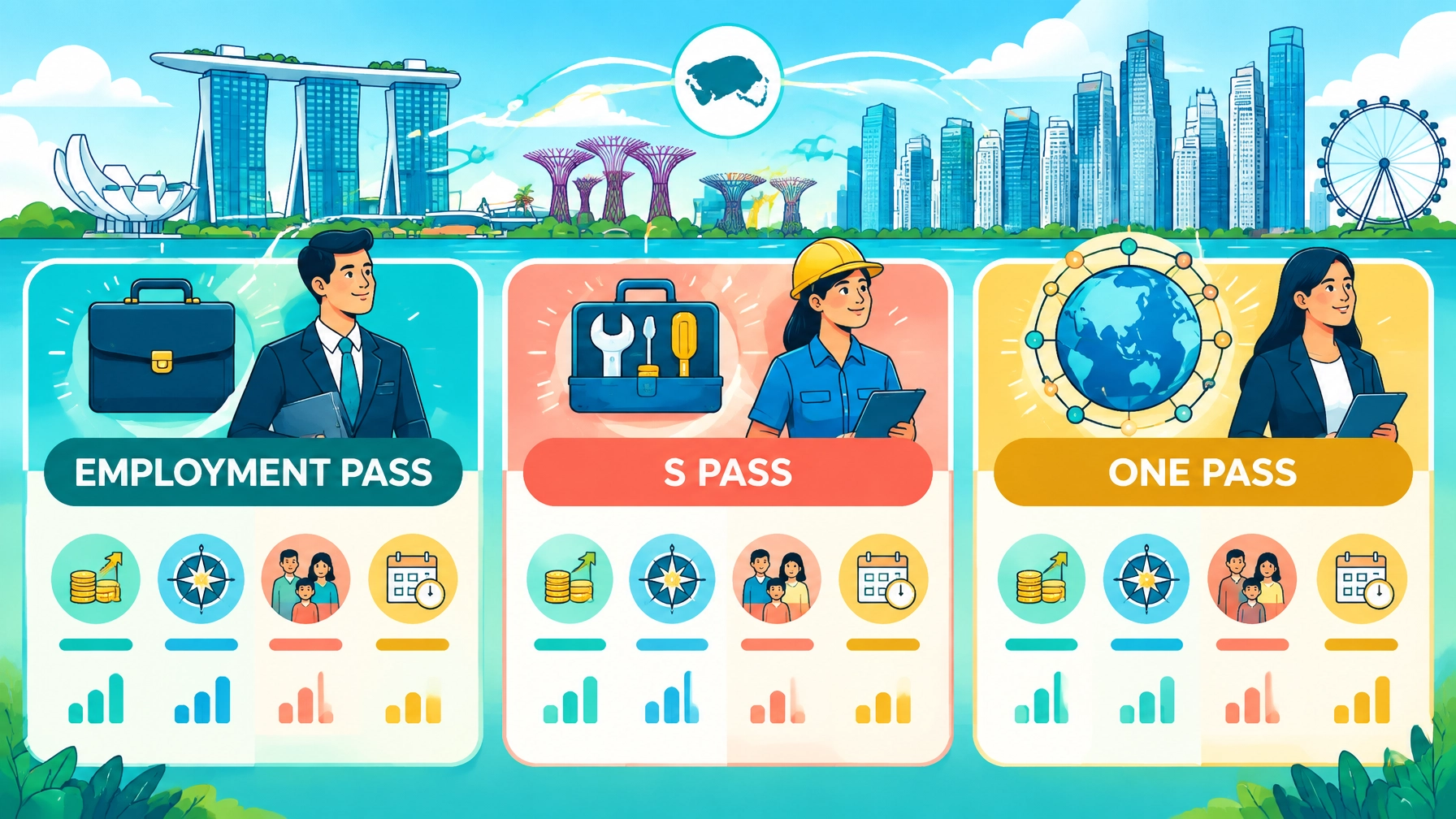
| Feature | Employment Pass | S Pass | ONE Pass |
|---|---|---|---|
| Designed for | Professionals, managers, executives and technicians | Skilled associate professionals and technicians | Top global talent and senior leaders |
| Minimum salary from 2027 | S$6,000; S$6,600 in financial services for younger applicants | S$3,600; S$4,000 in financial services for younger applicants | Generally S$30,000 monthly |
| Age scaling | Yes | Yes | Not structured like EP/S Pass |
| COMPASS | Usually mandatory; 40 points required | Not applicable | Exempt |
| Quota and levy | No S Pass quota or levy | Employer quota and levy apply | No quota or levy |
| Typical validity | Up to 2 years initially; renewals can be up to 3 years | Up to 2 years initially; renewals can be up to 3 years | Up to 5 years |
| Changing employers | New EP application required | New S Pass application required | No need to reapply when changing jobs |
| Family eligibility | DP generally available at S$6,000 fixed monthly salary | DP generally available at S$6,000 fixed monthly salary | Eligible spouse and children can apply under separate rules |
| PR route | May apply under the Professionals, Technical Personnel and Skilled Workers scheme | May apply under the PTS scheme | May apply, subject to ICA assessment |
📥 Landing in Singapore? Sort the paperwork first
Visa type, salary floor, family eligibility, housing budget and banking setup all interlock. The free Relocation Checklist walks you through each step in the right order so nothing catches you out after you have signed the offer.
💳 Arriving on an EP or S Pass? Compare Singapore accounts built for new arrivals and expatriates, including multi-currency options from HSBC Premier.
Disclosure: NearMe.SG may earn a commission from some links on this page. This does not affect our editorial recommendations.
1. Employment Pass: The Main Route for Professional Jobs
The EP is generally the right target if you are taking a professional, managerial, executive or specialist role in Singapore.
From 1 January 2027, the minimum qualifying salary for new EP applications will be:
-
S$6,000 for most sectors, rising progressively with age to S$11,500 at age 45 and above.
-
S$6,600 for financial services, rising progressively with age to S$12,700 at age 45 and above.
That headline salary is only the first stage.
COMPASS is the second stage
Most EP candidates must score at least 40 points under the Complementarity Assessment Framework, or COMPASS. The framework assesses:
-
C1 Salary: how your pay compares with local professionals in your sector and age group.
-
C2 Qualifications, including degree-equivalent and recognised top-tier qualifications.
-
C3 Diversity: your nationality’s representation among the employer’s PMET workforce.
-
C4 Support for local employment: the employer’s local PMET share compared with its sector.
-
C5 Skills bonus, for eligible roles on the Shortage Occupation List.
-
C6 Strategic Economic Priorities bonus, for qualifying companies participating in approved programmes.
Each foundational criterion can contribute 0, 10 or 20 points. A high salary can improve your C1 score, but it cannot automatically repair weak firm-level diversity or local-employment scores.
Applicants with a fixed monthly salary of at least S$22,500 are exempt from COMPASS, as are certain intra-corporate transferees and short-term roles.
Your practical move: Ask the prospective employer to use MOM’s Employment Pass Self-Assessment Tool before you resign from your current job.
2. S Pass: Affected by Both Salary and Employer Quota
The S Pass is designed for skilled foreign employees in associate professional and technician roles. It is not simply a “cheaper EP”. Your employer must also have available quota and pay the applicable levy.
As of 1 September 2026, the S Pass minimum qualifying salary is:
-
S$3,300 outside financial services, rising progressively with age to S$4,800.
-
S$3,800 in financial services, rising progressively with age to S$5,650.
For new applications from 1 January 2027, the minimum becomes:
-
S$3,600 outside financial services, rising with age to S$5,100.
-
S$4,000 in financial services, with the age-benchmarked table reaching S$5,650 at age 45 and above.
The salary must be comparable to the top one-third of local associate professionals and technicians by age. Qualifications are optional to declare, but any declared qualification must be authentic and awarded by an accredited institution listed in the application system.
S Pass holders can apply for a Dependant’s Pass for a legally married spouse and unmarried children under 21 if they earn at least S$6,000 in fixed monthly salary. This is based on your salary, not combined household income.
The catch is important: the S Pass is subject to employer quota and levy. A company may want to hire you but still be unable to secure the pass if its foreign-worker headcount is already near the limit.
3. ONE Pass: For High-Earning Global Talent
The Overseas Networks & Expertise Pass, better known as the ONE Pass, is a different category altogether.
It is designed for top talent in business, arts and culture, sports, academia, research and technology. Standard eligibility generally requires either:
-
At least S$30,000 monthly fixed salary for the 12 consecutive months before applying; or
-
A prospective Singapore job paying at least S$30,000 monthly with an established company; or
-
Outstanding achievements in selected fields.
The pass can be issued for up to 5 years, does not require a foreign-worker quota or levy and allows you to work for, start or operate multiple companies. You also do not need to reapply for a new pass simply because you change jobs.
ONE Pass AI and Tech track starts on 28 January 2027
For experienced technology leaders, this is one of the most significant upcoming changes.
Under the AI and Tech track, eligible candidates must have:
-
At least S$30,000 monthly compensation for 12 consecutive months;
-
At least S$22,500 in fixed monthly salary;
-
The balance potentially made up of vested non-cash components, such as ESOP or ESOW, subject to MOM assessment;
-
At least 5 cumulative years of experience within the past 10 years as a founder or C-suite executive in a tech firm, senior technical professional or both.
The candidate’s current or previous employer must also meet specific size, valuation, revenue, assets-under-management or fundraising criteria.
This is not a workaround for an ordinary EP application. It is a specialist route for senior technology talent with a strong compensation history and demonstrable leadership or technical experience.
The Five Timing Mistakes You Can Still Avoid

1. Waiting until after 1 January 2027
If you are eligible for an EP or S Pass under the current rules, delaying a new application past 1 January 2027 may push you into the higher salary regime.
Do not assume that signing an employment contract before the deadline is enough. Your employer should confirm the application timing and submission requirements with MOM.
2. Using the wrong renewal date
For existing EP and S Pass holders, the new thresholds apply to renewals of passes expiring on or after 1 January 2028.
An existing S Pass holder whose pass expires on or after 1 September 2026 is already affected by the S$3,300 or S$3,800 thresholds. The 2027 increase is a further step, not the first change.
3. Checking only the headline salary
A 30-year-old applicant cannot automatically use the “S$6,000 EP salary” as their personal benchmark. Salary thresholds rise progressively with age.
For example, from 2027, an EP applicant aged 30 in a non-financial sector faces a benchmark of approximately S$7,750, not S$6,000. Your employer should check the age-specific MOM table and the relevant sector.
4. Assuming a high salary guarantees EP approval
You still need COMPASS unless exempt. A candidate can meet the qualifying salary but fail to reach 40 points because of qualifications, nationality concentration or the employer’s local PMET profile.
Ask for a COMPASS assessment before finalising your move.
5. Forgetting your family’s salary threshold
If you plan to bring your spouse or children, the key number is S$6,000 fixed monthly salary for an EP or S Pass holder. A lower-paid S Pass role may work for you individually but create a serious family-planning problem.
For housing, schools, transport and other relocation costs, build your budget before accepting the offer. 🏠 See NearMe.SG’s Singapore Moving and Housing Guide for practical local planning tips.
📥 Before you sign the offer, check the whole picture
A work pass is only one line in the plan. Download the free Relocation Checklist for the visa, housing, salary-benchmark and banking steps to work through in order — so a timing mistake or a family-eligibility gap does not cost you the move.
💳 Starting fresh in Singapore? Set up your banking before you land — compare new-arrival and expatriate accounts, including HSBC Premier’s multi-currency options.
Disclosure: NearMe.SG may earn a commission from some links on this page. This does not affect our editorial recommendations.
Which Pass Should You Aim For?
-
Choose the EP if you are a professional candidate whose employer can support both salary eligibility and COMPASS.
-
Choose the S Pass if your role and salary fit the skilled APT category and your employer has sufficient quota.
-
Explore the ONE Pass if you are a senior global leader, founder, researcher, creative professional or technology specialist earning at the required level.
-
If permanent residence is part of your long-term plan, remember that none of these passes guarantees PR. ICA considers factors such as your salary, qualifications, employment history, family profile, length of residence and integration.
Singapore’s work-pass landscape is becoming more selective, and the opportunities are not getting easier to secure. The smartest strategy is to check your exact age, sector, salary, employer profile and family needs now. Before the next threshold takes effect.
This article is for general information and is not immigration or legal advice. Confirm the latest requirements directly with Singapore’s Ministry of Manpower and Immigration & Checkpoints Authority.
Official resources
RELATED POSTS
View all



Expert Guide on Springleaf Residence Condo: 2025 Free Tips
June 15, 2025 | by nearme.sg

Freehold Landed Property in Singapore Under S$5M: Free Expert Guide
June 4, 2025 | by nearme.sg