


Home Renovation in Singapore: Budgeting, Contractors & What to Expect (2026)
August 11, 2026 | by nearme.sg


Home renovation in Singapore can be a significant investment, and the biggest mistake is treating the contractor’s quotation as the entire budget. It is not. Your real cost also includes permits, hacking, electrical work, plumbing, carpentry, appliances, temporary accommodation, defects and the occasional “small change” that quietly becomes a four-figure bill.
Planning your first HDB or condo renovation? This HDB renovation guide breaks down the typical costs, renovation rules, timeline, contractor options and money-saving checks you need before signing anything.
📥 Free Renovation Budget Cheatsheet
Get our step-by-step guide to plan your renovation costs without overspending.
Looking for the best deal on this? You can compare cost per application on SingSaver.
Disclosure: NearMe.SG may earn a commission from some links on this page. This does not affect our editorial recommendations.
For a head start, 🚀 COMPARE LOCAL RENOVATION SERVICES ON NEARME.SG NOW and build a shortlist before requesting quotations.
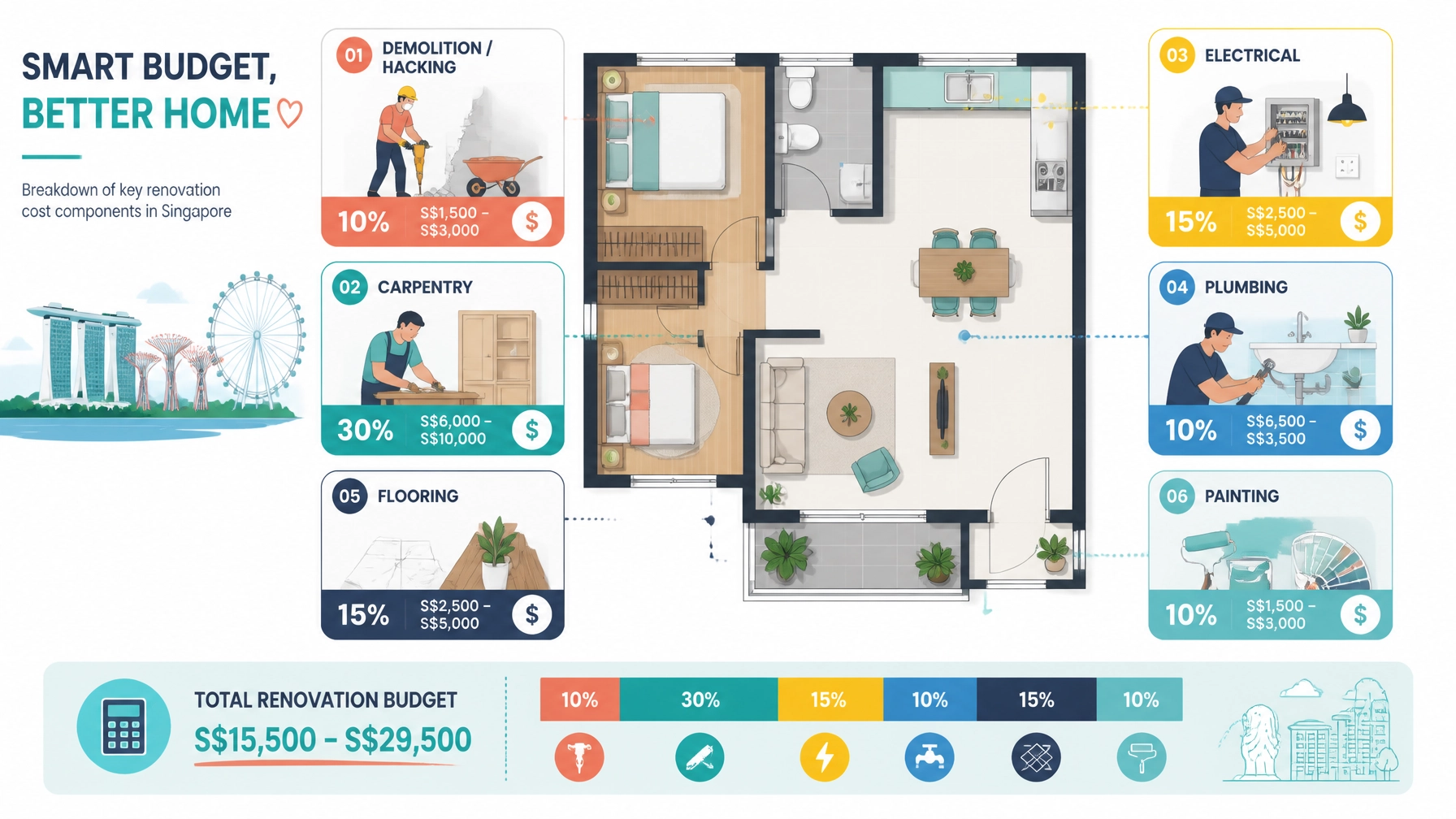
1. What Actually Goes Into a Home Renovation?
A renovation is a chain of connected trades. Changing one part of your home can affect several others, so you need a clear scope from the beginning.
Hacking and demolition
Hacking may involve removing:
-
Existing floor or wall tiles
-
Kitchen cabinets and wardrobes
-
Non-structural partition walls
-
Old bathroom fittings
-
Built-in platforms or feature walls
Resale flats often cost more because contractors may need to remove old finishes before installing new ones. Structural beams, columns, slabs, load-bearing walls and household shelter components must not be hacked.
Carpentry
Carpentry is one of the largest cost drivers in a Singapore renovation. It can include:
-
Kitchen cabinets
-
Bedroom wardrobes
-
TV consoles
-
Shoe cabinets
-
Study desks
-
Storage platforms
-
Vanity units
Custom carpentry is convenient, but every additional cabinet, drawer, laminate finish and internal accessory adds to the bill. Measure your storage needs carefully instead of filling every wall with built-ins.
Electrical work
Electrical work may include new power points, lighting points, switches, track lights, appliance points and rewiring. Older resale flats may need more extensive rewiring, while newer units may only require additional points.
Ask whether the quotation includes wiring, trunking, switches, installation and testing. “Electrical works” is too vague on its own.
Plumbing and sanitary work
Plumbing covers sinks, water points, toilets, shower fittings, washing-machine points and drainage. Bathroom renovation requires particular care because poor waterproofing can create leaks that affect your neighbours downstairs.
Flooring
Your options may include tiles, vinyl, laminate, engineered wood or timber flooring. Costs depend on material, preparation, screeding, removal of existing flooring and installation complexity.
For new BTO flats, check the latest HDB restrictions before hacking bathroom tiles or altering waterproofing. Do not assume an attractive renovation package automatically complies with HDB requirements.
Painting and finishing
Painting usually comes near the end, after major dusty work and carpentry installation. Budget for primer, ceiling paint, wall paint, touch-ups and special finishes such as textured paint or feature walls.
2. Renovation Costs in Singapore in 2026
Let’s talk numbers. A realistic full renovation in Singapore generally falls between S$30,000 and S$90,000, although premium resale projects and luxury condos can go significantly higher.
These are planning ranges, not fixed market prices:
| Home type | Indicative renovation budget | Approximate planning rate |
|—|—:|—:|
| 3-room BTO | S$30,000–S$55,000 | S$35–S$75 per sq ft |
| 4-room BTO | S$40,000–S$75,000 | S$35–S$70 per sq ft |
| 5-room BTO | S$50,000–S$90,000 | S$35–S$70 per sq ft |
| 3-room resale | S$45,000–S$75,000 | S$55–S$105 per sq ft |
| 4-room resale | S$55,000–S$90,000 | S$50–S$100 per sq ft |
| Mass-market condo | S$60,000–S$120,000+ | About S$80–S$120 per sq ft |
A new BTO usually costs less because the flooring, sanitary fittings and finishes may already be provided. A resale flat can require hacking, retiling, rewiring, plumbing replacement and repairs before the decorative work even starts.
Quick renovation budget calculator
Use this simple formula for an early estimate:
Estimated budget = floor area × planning rate + 10% to 15% contingency
For example, a 4-room resale flat measuring approximately 1,000 sq ft:
-
Moderate planning rate: S$70 per sq ft
-
Base estimate: 1,000 × S$70 = S$70,000
-
Contingency at 10%: S$7,000
-
Safer working budget: about S$77,000
This is not a quotation, but it helps you identify whether a proposed budget is realistic before you spend time attending multiple consultations.
💰 DON’T OVERPAY: START COMPARING SINGAPORE LOCAL SERVICE PROVIDERS ON NEARME.SG
3. Interior Designer or Direct Contractor?
The right choice depends on your renovation complexity, time and confidence.
Choose an interior designer if you want:
-
A complete space-planning concept
-
Help selecting finishes and colours
-
One team coordinating multiple trades
-
3D drawings or detailed design proposals
-
Support with site supervision and defect checks
The downside is cost. An ID may charge design fees, coordination margins or higher package prices. You should also confirm who actually carries out the works and whether subcontractors are used.
Choose a direct contractor if you want:
-
A simpler renovation
-
More direct communication with tradespeople
-
Greater control over materials
-
Potentially lower coordination costs
-
A focused scope, such as painting, flooring or carpentry
The trade-off is that you may need to coordinate different vendors yourself. This can become stressful if electrical, plumbing and carpentry schedules overlap.
Pick an ID for a complex, whole-home renovation. Pick a direct contractor for clearly defined works that you understand well. Either way, insist on a written quotation and contract.
4. HDB vs Condo Renovation Rules
HDB renovation rules
For HDB flats, permit requirements may apply to building, plumbing, electrical, air-conditioning, window and other renovation works. Hacking walls, altering bathrooms, changing flooring levels or relocating plumbing should never be treated as informal works.
HDB also prohibits work that compromises structural integrity, including hacking structural elements or tampering with the household shelter. Window works must be done by the appropriate approved contractor.
Read the official HDB renovation guidelines and ask your contractor to confirm which permits are required before work starts.
Noisy work such as hacking and heavy drilling is commonly restricted to weekday daytime hours, often around 9am to 5pm, with no noisy work on Sundays, public holidays and certain restricted periods. General works may have different permitted hours. Your approved renovation permit and current HDB rules take priority.
Condo renovation rules
Condo owners must usually obtain MCST approval before renovation begins. The management corporation may require:
-
Renovation application forms
-
Floor plans and work schedules
-
Contractor insurance details
-
A refundable renovation deposit
-
Protection for lifts and common areas
-
Strict working-hour compliance
-
Advance notice to neighbours
MCST rules can be stricter than HDB rules. Balcony changes, external windows, main doors, air-conditioning trunking and façade-visible works may be restricted. Get the latest by-laws in writing before paying a deposit.
5. The Renovation Process and Timeline
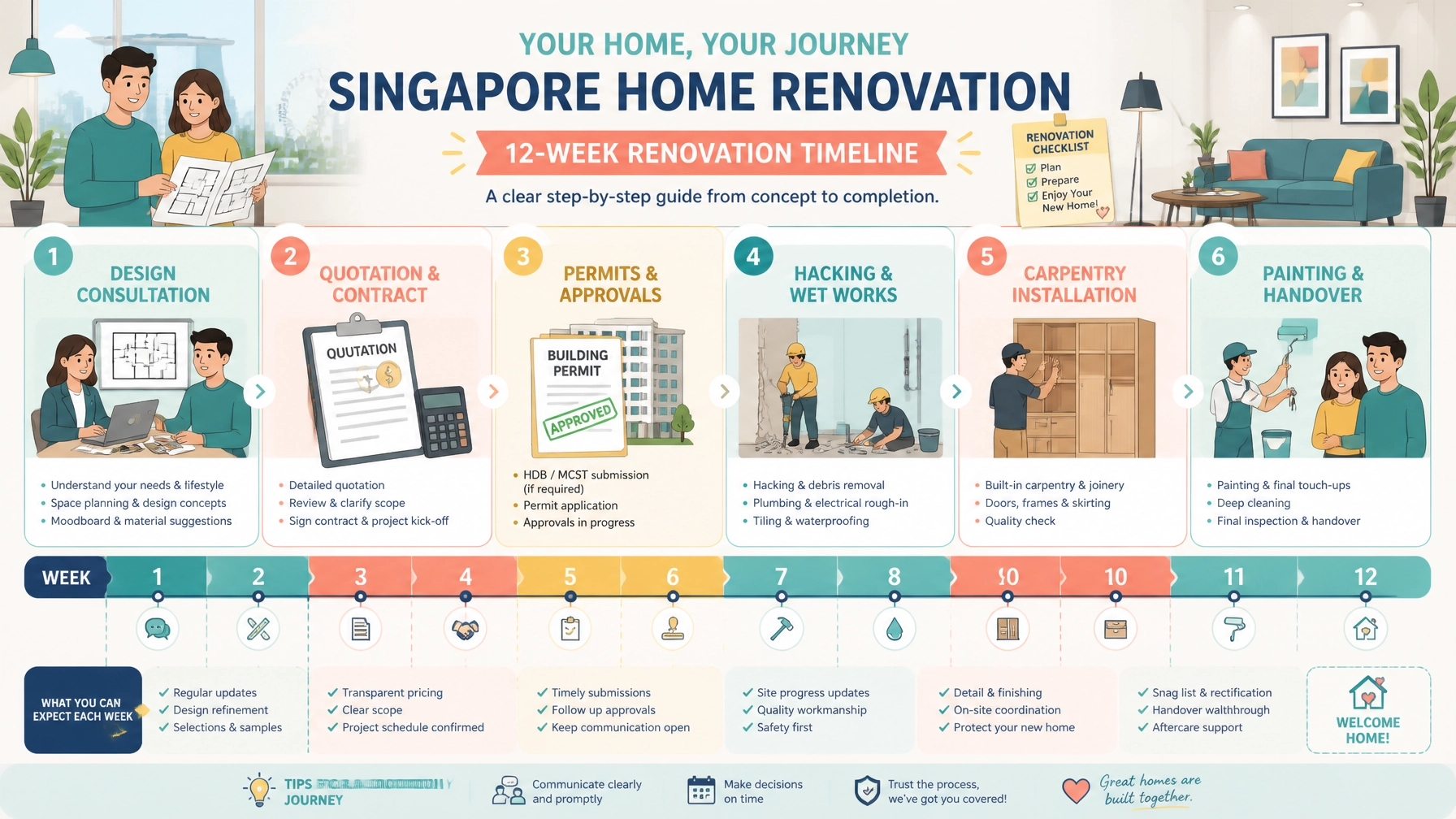
A typical Singapore home renovation takes around 6 to 12 weeks, excluding delays caused by permits, material shortages, design changes or defects.
The usual sequence is:
-
Weeks 1–2: Planning and quotation
Confirm your brief, budget, floor plan, materials and contractor. -
Weeks 2–3: Approvals and preparation
Apply for HDB permits or MCST approval. Protect common areas and notify neighbours. -
Weeks 3–4: Hacking and demolition
Remove unwanted flooring, walls, fixtures and built-ins. -
Weeks 4–6: Masonry, plumbing and electrical
Complete wet works, waterproofing, screeding, wiring and concealed services. -
Weeks 6–9: Flooring, painting and carpentry
Install finishes, paint surfaces and fit built-in furniture. -
Weeks 9–12: Fixtures, testing and handover
Install lights, sanitary fittings, appliances and accessories. Conduct a detailed defects inspection.
Build a buffer into your move-in plan. If your lease ends shortly after renovation, even a one-week delay can create expensive storage and temporary accommodation costs.
6. How to Shortlist and Vet Contractors or IDs
Do not select a contractor based on the cheapest quotation alone. Compare the scope line by line.
Check the following:
-
HDB registration where relevant
-
CaseTrust accreditation or other consumer-protection credentials
-
Business registration and physical contact details
-
Recent project photographs
-
Reviews from real customers
-
Warranty and defect-repair terms
-
Subcontractor arrangements
-
Renovation permit experience
-
Payment milestones
-
Insurance and damage-deposit requirements
You can also check the HDB Directory of Renovation Contractors and learn more about CaseTrust accreditation.
Visit completed projects or showflats where possible. Look closely at cabinet alignment, silicone finishing, tile joints, paint edges and storage usability. A polished showroom is not proof of consistent workmanship.
🔎 VET YOUR SHORTLIST: FIND AND COMPARE LOCAL SERVICE PROVIDERS THROUGH NEARME.SG
7. Red Flags and Expensive Mistakes to Avoid
Watch out for these warning signs:
-
A quotation far below every other comparable quote
-
Large upfront payment before materials or work are confirmed
-
Verbal promises that do not appear in the contract
-
Vague terms such as “electrical works” or “standard carpentry”
-
No itemised material specifications
-
Pressure to sign immediately
-
Frequent changes in salesperson or project manager
-
No clear defects liability period
-
Unexplained variation orders
-
Contractor unwilling to show completed work
A sensible payment schedule should follow measurable milestones rather than demand most of the money upfront. Keep a written record of every approved change, including WhatsApp confirmations, revised drawings and updated prices.
FAQ: Home Renovation in Singapore
How much should I budget for a 4-room HDB renovation?
A reasonable 2026 planning range is approximately S$40,000 to S$90,000, depending on whether the flat is BTO or resale, the amount of hacking, carpentry, rewiring and bathroom work.
Do I need an HDB renovation permit?
Some renovation works require HDB approval or must be completed by approved contractors. Ask your contractor to check the latest HDB guidelines before hacking, altering plumbing, changing windows or modifying electrical systems.
Is an ID more expensive than a direct contractor?
Usually, an ID costs more because you are paying for design, coordination and project management. The additional cost can be worthwhile for a complex renovation, but a direct contractor may suit a simple, tightly defined scope.
How long does renovation take?
Allow 6 to 12 weeks for a typical renovation, plus time for permits, MCST approvals, material lead times and rectification. Resale flats with extensive hacking usually need more time.
How much contingency should I keep?
Keep at least 10% to 15% of your renovation budget as a contingency. For older resale flats, a larger buffer may be sensible because hidden plumbing, electrical or structural issues can appear after demolition.
Renovation is a major investment, but it does not need to become a financial headache. Define your scope, compare like-for-like quotations, verify contractor credentials and protect your budget with a contingency. Do that, and your new home can move from dusty construction site to comfortable Singapore sanctuary with far fewer surprises.
✅ PLAN YOUR NEXT MOVE: EXPLORE NEARME.SG FOR RELIABLE LOCAL SERVICES
📥 Free Renovation Budget Cheatsheet
Get our step-by-step guide to plan your renovation costs without overspending.
Looking for the best deal on this? You can compare cost per application on SingSaver.
Disclosure: NearMe.SG may earn a commission from some links on this page. This does not affect our editorial recommendations.
RELATED POSTS
View all


Freehold Landed Property in Singapore Under S$5M: Free Expert Guide
June 4, 2025 | by nearme.sg
Singapore Landed Homes Out of Reach Soon? Expert Views
January 18, 2026 | by nearme.sg